
Sleep and Longevity: What the Research Really Shows
Sleep duration and mortality risk are linked, but not in the way many articles suggest: large cohort studies and the American Heart Association point to a U-shaped relationship rather than a linear «more is better». An overview of the figures, the limits of the evidence, and what the research does not show.
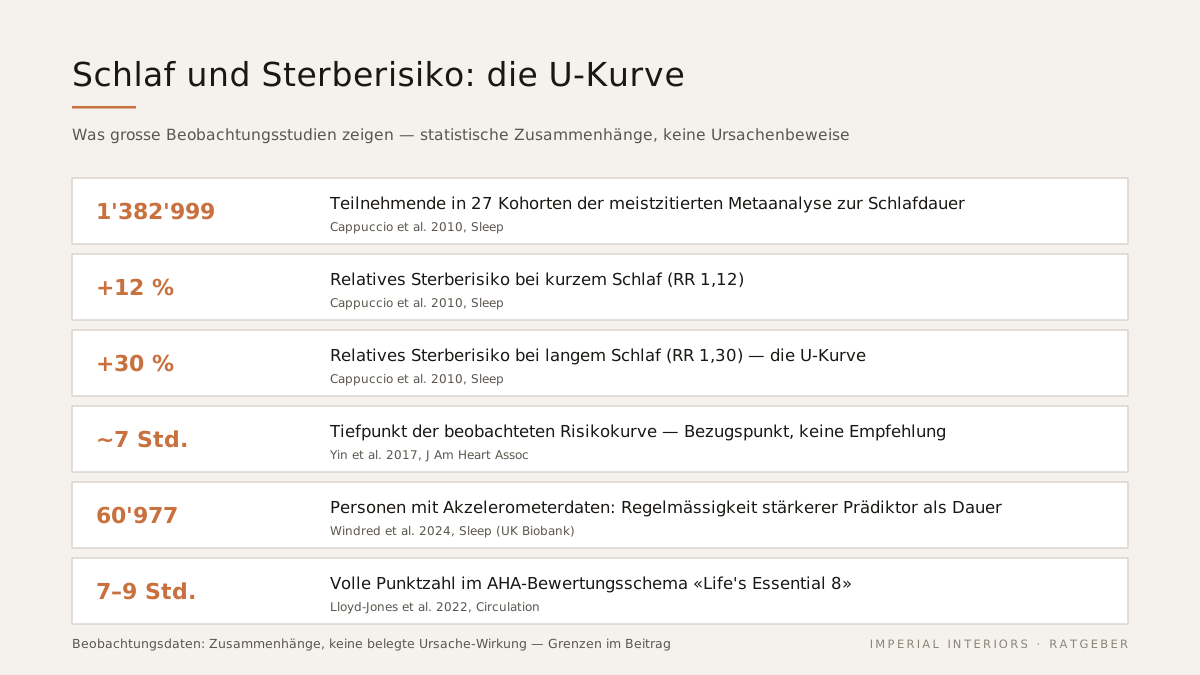
The short answer: what the research on sleep and mortality risk shows
Sleep and longevity are a popular topic, but the research behind it is more sober than many guides suggest. Large population studies do not measure «longevity» or healthy life years as a separate quantity; they measure mortality risk as a function of sleep duration and regularity. The term «longevity» is used in this article as a thematic framing for search purposes, not as a measure used in the cited studies themselves. What shows up across several large cohort studies and in the American Heart Association's scoring scheme is this: both short and long sleep are statistically associated with a higher mortality risk than a medium sleep duration — the relationship is U-shaped, not linear. All the studies named below are also observational studies: they show statistical associations, not proven cause-and-effect chains. According to this data, no bed, mattress or light fitting can lower mortality risk — the studies make no claim about that at all.
The U-curve: why «ever more sleep» misreads the data
The largest and most-cited basis is a 2010 meta-analysis by Cappuccio and colleagues: 16 prospective cohort studies with 27 independent cohorts, 1'382'999 participants and 112'566 deaths, with observation periods of 4 to 25 years, sleep data drawn mostly from self-reported questionnaires. The study found that short sleep duration was associated with a 12% higher relative mortality risk (RR 1.12). Long sleep duration was associated with an even greater increase in risk, 30% (RR 1.30) — the authors themselves read this as a U-shaped relationship between sleep duration and mortality, not a linear «more sleep is always better».
A dose-response meta-analysis by Yin and colleagues (2017), which reviewed the literature up to December 2016 — also based mostly on self-reported sleep duration — finds the same pattern for all-cause mortality as well as for cardiovascular disease, coronary heart disease and stroke: a U-shaped relationship with the lowest observed risk at around 7 hours of sleep per day. Below 7 hours, the pooled relative mortality risk rose by 6% per hour of shorter sleep. Above 7 hours, the increase in risk per additional hour was even more pronounced than for short sleep: 13% higher mortality risk per hour, and for stroke as much as 18% per additional hour of sleep beyond 7 hours. The roughly 7 hours found in this study is the low point of the observed risk curve — a statistical reference point, not a recommendation from the authors.
Correlation is not causation — the study authors stress this themselves
The authors of the underlying studies explicitly point out this limitation. Cappuccio and colleagues note that the link between long sleep and mortality risk could also be explained by unmeasured confounding factors — such as depression, low socioeconomic status, low physical activity, undiagnosed illness or cancer-related fatigue — and call for further research to clarify whether sleep duration is a cause or merely a marker of poor health status. Yin and colleagues likewise stress that only long-term randomised controlled trials could demonstrate a causal effect of sleep duration on mortality — their own meta-analysis provides only observational evidence for this. Even the American Heart Association states in its advisory that there is little evidence that improving sleep duration or sleep quality reduces the incidence of cardiovascular disease. In practice, this means: the figures in this article describe statistical associations across large population groups, not an individual prediction, and not a proven effect of «more» or «more regular» sleep on one's own mortality.
Regularity, not just duration: a more recent UK Biobank study
A more recent study by Windred and colleagues (2024) shifts the focus from pure sleep duration to sleep regularity. It is based on a UK Biobank cohort with objective accelerometer data from 60'977 people with an average age of 62.8 years, more than 10 million hours measured, and a mortality follow-up of up to 7.8 years. The result: sleep regularity, measured using a regularity index, was a stronger predictor of all-cause mortality in this cohort than sleep duration alone. Participants in the four most regular sleep quintiles had a 20 to 48% lower risk of all-cause mortality than the least regular group, even after adjusting for age, sex, ethnicity, and sociodemographic, lifestyle and health factors. The same caveat applies here too: the authors themselves point out that their findings are purely correlational, and that sleep regularity could be either a cause or merely a marker of premature mortality. The sample also comes from a predominantly older, ethnically homogeneous population, with only one week of measurement per person — so it cannot readily be generalised to younger or more ethnically diverse groups.
What professional bodies make of this: the AHA and «Life's Essential 8»
At the level of professional bodies, this body of research has made its way into official scoring frameworks: in 2022 the American Heart Association added sleep duration as the eighth component of its definition of cardiovascular health («Life's Essential 8»), captured as self-reported average hours of sleep per night. In the scoring scheme, 7 to under 9 hours of sleep per night receives the full score of 100 possible points; both shorter and longer sleep duration — including 10 hours or more — scores lower, deliberately reflecting the U-shaped relationship. The basics of sleep needs, the immune system and Swiss figures are covered in our guide «Why Good Sleep Matters» — this article focuses on the mortality data and its limitations.
What this means in practice
What remains for everyday life is sober guidance, not a promise: in the large population studies and in the American Heart Association's scoring scheme, a sleep duration of 7 to 9 hours per night fares best — markedly shorter as well as markedly longer sleep shows a higher statistical mortality risk in the same data. In addition, in the study by Windred and colleagues, the regularity of sleep timing was more closely linked statistically to all-cause mortality than the number of hours alone — an association drawn from observational data, not a proven effect. None of the cited studies shows any link between the quality of a mattress, bed or light fitting and these mortality figures; anyone who nonetheless wants to reconsider their own sleep environment will find space to try lying down at our premises at Nüschelerstrasse 30 in Zurich — as an aid to deciding how a bed feels to you personally, not as evidence for a research finding.
Frequently asked questions
Is more sleep automatically better for mortality risk?
No. Both the meta-analysis by Cappuccio and colleagues (2010) and the dose-response meta-analysis by Yin and colleagues (2017) found a U-shaped relationship: not only short sleep but also long sleep was statistically linked to a higher mortality risk. In Cappuccio and colleagues, the relative risk for long sleep was even higher (30%) than for short sleep (12%). «Ever more sleep is always better» cannot be derived from this data.
According to these sources, what sleep duration is considered favourable?
In its «Life's Essential 8» scoring scheme, the American Heart Association awards the full score (100 of 100) for 7 to under 9 hours of sleep per night; shorter and longer sleep duration — including 10 hours or more — scores lower. In the meta-analysis by Yin and colleagues (2017), the lowest observed mortality risk was at around 7 hours of sleep per day; there, this figure is the low point of the risk curve, not a formal recommendation.
Does this mean too little sleep shortens life?
That would be over-interpreting the evidence. All the studies cited here are observational studies, not controlled experiments. The authors of Cappuccio and colleagues (2010) themselves point out that the link between sleep duration and mortality could also be explained by unmeasured confounding factors such as depression, low physical activity or undiagnosed illness, and call for further research into whether sleep duration is a cause or merely a marker of poor health status. Yin and colleagues (2017) likewise stress that only long-term randomised trials could demonstrate a causal effect.
Is sleep regularity more important than sleep duration alone?
A UK Biobank study by Windred and colleagues (2024), using objective accelerometer data from 60'977 people, found that sleep regularity was a stronger predictor of all-cause mortality than sleep duration alone. The four most regular sleep quintiles showed a 20 to 48% lower mortality risk than the least regular group. This study, too, is purely correlational, and the authors themselves note the limited generalisability of their predominantly older sample.
What exactly does «longevity» mean in this context?
In the studies cited here, «longevity» or healthspan is not used as a separate measure — what is measured is mortality, i.e. the risk of death within the respective observation period. «Longevity» is therefore used in this article as a thematic framing, not as a measure for healthy life years that is used or established in the research itself.
Sources & studies
The factual statements in this article are based on the following sources — each framed in the text as a study, testing institute, official figure, convention or manufacturer information:
Note: This article provides general knowledge and does not replace medical advice. Persistent complaints should be clarified by a doctor.
Prefer personal advice?
Initial consultation, first home visit and initial concept are free and non-binding. Try our beds any time in the showroom at Nüschelerstrasse 30, Zurich.