
Sleep Divorce: When Couples Sleep Apart
The term «Sleep Divorce» keeps coming up whenever couples sleep in separate rooms, at least some of the time. Drawing on a US survey and several sleep studies, this article looks at how common the practice is, what reasons are given for it — and where the evidence reaches its limits.
What «Sleep Divorce» means — and how common it is
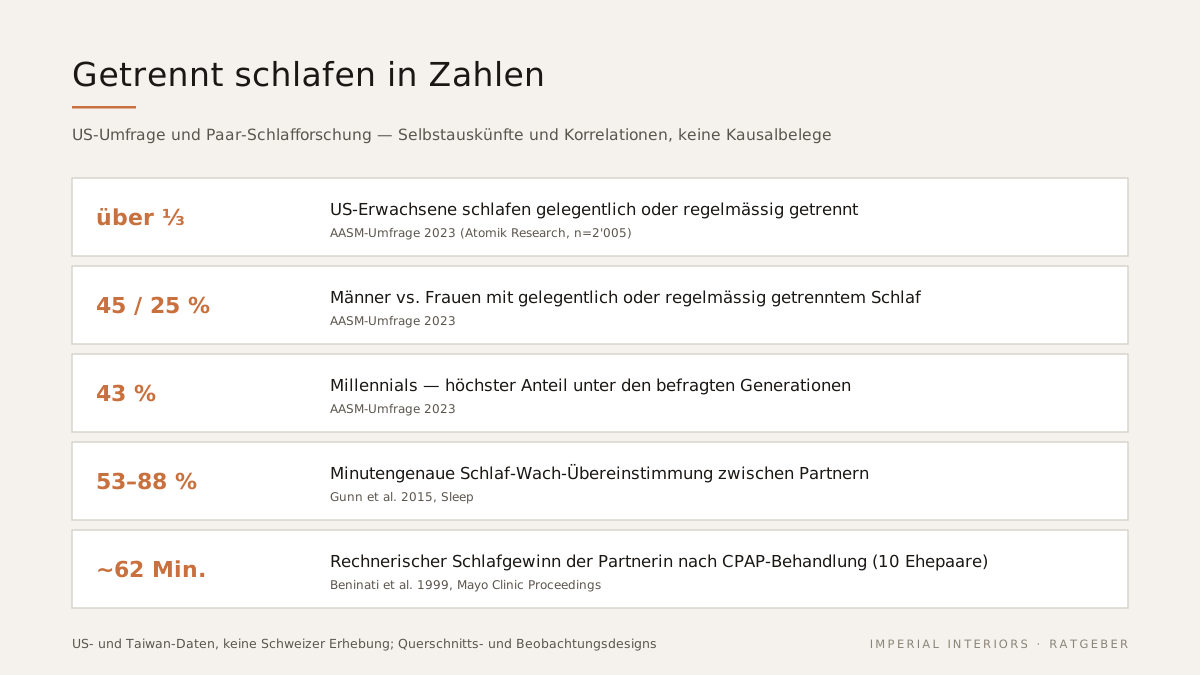
The term «Sleep Divorce» describes couples who sleep in separate rooms or beds, at least some of the time, in order to rest better. How common this behaviour is was examined in summer 2023 by the US professional body American Academy of Sleep Medicine (AASM) through a survey. According to this online survey of US adults, commissioned by the AASM and carried out by the market research provider Atomik Research, more than a third of respondents sleep occasionally or regularly in a different room from their partner. Important for context: this is a self-reported survey from the US, not a scientific study with a control group — and not Swiss figures. To our knowledge, no robust surveys on «Sleep Divorce» exist for Germany, Austria or Switzerland.
The same survey shows a clear difference by gender: 45 percent of the men surveyed said they occasionally or regularly slept apart, compared with 25 percent of women. There were also differences between generations, according to the survey: 43 percent of millennials reported sleeping apart, compared with 33 percent of Generation X, 28 percent of Generation Z and 22 percent of baby boomers.
Reasons: snoring, movement in bed, and the AASM's view
Why do couples opt for separate rooms? AASM spokesperson Dr Seema Khosla frames the trend as follows in the press release accompanying the survey: poor sleep can worsen mood, and people whose sleep is disrupted are more likely to argue with their partner; this can breed resentment towards the person disturbing their sleep. Even so, Khosla says, «Sleep Divorce» does not in most cases signal a relationship crisis, but simply means that sleep is being prioritised, with a move to a separate room when needed. This is an expert quote from a professional body's press release, not a study with its own sample — the conflict and mood associations mentioned are not backed there by primary sources.
One specific, frequently cited trigger is snoring. The AASM classes loud snoring as a possible warning sign of obstructive sleep apnoea and, in that case, explicitly recommends medical assessment rather than simply sleeping apart — advice that applies to both sexes and is no substitute for self-diagnosis.
Sheer movement in bed also plays a role. An older, still widely cited British actimetry study of 46 couples (Pankhurst and Horne, 1994) showed that bed partners' movements were partly transmitted to each other during the night, and that women felt disturbed by this more often than men. At the same time, the majority of respondents in the same study said they slept better with a partner than alone — both observations belong to the picture. A more recent Australian actigraphy study of 55 healthy couples with no diagnosed sleep disorder (Walters et al., 2020, Melbourne) found that, on average, a good one in five of a partner's nocturnal awakenings directly followed the other partner's preceding awakening — a measure of mutual disturbance in a shared bed, not of its cause.
What sleep research shows about couples and relationships
The link between sleep and romantic relationships is not a new topic in sleep research. A frequently cited review article (Troxel, 2010) established the approach of studying sleep not only individually but as a shared, «dyadic» behaviour of couples — as a framework for further research, not as a study with its own measurements.
A study of US couples in Pittsburgh (Gunn et al., 2015, 10 days of actigraphy) found minute-by-minute sleep-wake concordance between partners of 53 to 88 percent; among wives with high relationship satisfaction, this concordance was higher. The authors explicitly leave open which way the association runs — whether a satisfying relationship leads to more concordance, or the reverse. This does not amount to evidence of a causal effect of shared or separate sleep on the relationship.
The picture is different for medically treated sleep apnoea: in a very small, older sleep-laboratory study (Beninati et al., 1999, Mayo Clinic Proceedings, 10 married couples, all affected patients male), CPAP treatment was associated with fewer arousals and higher sleep efficiency in the wives, even on the very first night. The authors extrapolate this to around 62 additional minutes of sleep per night — a calculation based on an assumed 480 minutes of time in bed, not a measured value. This study concerns medical treatment of diagnosed sleep apnoea, not mattress or room choice, and the sample is very small.
For couples in which one person has diagnosed insomnia, the same researchers found in a further study (Walters et al., 2020, 52 couples, Melbourne) an even higher rate of mutual transmission of arousals than in healthy couples — with the healthy partners even more affected than the ones with the diagnosis. This finding comes from a specific clinical population and cannot be generalised to healthy couples at large.
Sleeping apart and loneliness: a finding that needs caveats
One finding deserves particular caution in how it is read. A cross-sectional study of 1'292 married older people in Taiwan (Chiao et al., 2021, BMC Geriatrics, aged 50 to 75, average age 62) found that sleeping apart was statistically associated with higher emotional loneliness. The authors explicitly stress that their cross-sectional design cannot establish causality: the association leaves open whether sleeping apart contributes to loneliness, whether conversely an already more distant relationship leads to both sleeping apart and loneliness, or whether other factors are behind it. The sample also comes from an older, culturally different population in Taiwan and cannot readily be applied to Switzerland. In practice, this means: the available research neither clearly supports nor clearly refutes sleeping apart as good or bad for a relationship — the data available throughout are observational or cross-sectional, not proof of cause and effect.
A middle ground: different firmness levels in the same bed
Anyone who would rather not move into separate rooms sometimes considers a middle ground: two mattresses, or two firmness levels, side by side in the same bed. As far as our research shows, this specific setup has not been directly studied scientifically in couples — all that is established is that individual firmness preference matters for lying comfort: a randomised trial in patients with chronic low back pain (Kovacs et al., 2003, The Lancet, 313 people) concerns individuals with a back-pain diagnosis, however, not couples, and not separate sleeping surfaces. How couples solve this division in practice — a continuous mattress, two cores, a topper to bridge the gap in the middle — is covered in detail in our guide to bed size and mattress division. At the Imperial Interiors showroom in Zurich, different firmness levels can be tried side by side — as a starting point for a personal consultation, not as a scientifically proven solution.
Frequently asked questions
What exactly does «Sleep Divorce» mean?
The term describes couples who sleep in separate rooms or beds, at least some of the time. According to AASM spokesperson Dr Seema Khosla, this does not in most cases signal a relationship crisis, but rather that sleep is being prioritised, with a move to a separate room when needed.
How many couples sleep apart, according to surveys?
According to a 2023 online survey of 2'005 US adults, commissioned by the American Academy of Sleep Medicine, more than a third of respondents sleep apart occasionally or regularly — 45 percent of men and 25 percent of women. This is a US self-reported survey, not a scientific study, and not Swiss figures.
Is sleeping apart bad for a relationship?
The available research does not give a clear answer. A cross-sectional study of older married people in Taiwan found a statistical association between sleeping apart and higher emotional loneliness — but the authors explicitly stress that their cross-sectional design cannot establish cause and effect. Other studies on sleep-wake concordance in couples are likewise purely correlational.
We sleep apart because of snoring — what does the AASM recommend?
The AASM recommends having loud snoring assessed by a doctor, since it can be a possible warning sign of obstructive sleep apnoea — in both men and women. Simply sleeping in separate rooms is no substitute for that assessment.
Is there an alternative to completely separate bedrooms?
Some couples choose two mattresses or different firmness levels in the same bed. No study scientifically examining this specific setup in couples exists; all that is established is that individual firmness preference matters for lying comfort. This can be tried out with different firmness levels in the showroom.
Sources & studies
The factual statements in this article are based on the following sources — each framed in the text as a study, testing institute, official figure, convention or manufacturer information:
- American Academy of Sleep Medicine (AASM), Pressemitteilung "Over a third of Americans opt for a 'sleep divorce'", 10.07.2023
- Troxel WM, "It's more than sex: exploring the dyadic nature of sleep and implications for health", Psychosomatic Medicine, 2010
- Beninati W, Harris CD, Herold DL, Shepard JW Jr., "The effect of snoring and obstructive sleep apnea on the sleep quality of bed partners", Mayo Clinic Proceedings, 1999
- Pankhurst FP, Horne JA, "The influence of bed partners on movement during sleep", Sleep, 1994
- Gunn HE, Buysse DJ, Hasler BP, Begley A, Troxel WM, "Sleep Concordance in Couples is Associated with Relationship Characteristics", Sleep, 2015
- Walters EM, Phillips AJK, Boardman JM, Norton PJ, Drummond SPA, "Vulnerability and resistance to sleep disruption by a partner: A study of bed-sharing couples", Sleep Health, 2020
- Walters EM et al., "Sleep and wake are shared and transmitted between individuals with insomnia and their bed-sharing partners", Sleep, 2020
- Chiao C, Lin WH, Chen YH, Yi CC, "Loneliness in older parents: marital transitions, family and social connections, and separate bedrooms for sleep", BMC Geriatrics, 2021
- Kovacs FM et al., "Effect of firmness of mattress on chronic non-specific low-back pain: randomised, double-blind, controlled, multicentre trial", The Lancet, 2003
Note: This article provides general knowledge and does not replace medical advice. Persistent complaints should be clarified by a doctor.
Prefer personal advice?
Initial consultation, first home visit and initial concept are free and non-binding. Try our beds any time in the showroom at Nüschelerstrasse 30, Zurich.