
Circadian Light and Sleep Rhythm: What the Research Shows
Not just how bright light is, but when and at what wavelength it reaches the eyes, influences the body clock and melatonin production, according to several laboratory studies. This guide reviews the evidence — including the light levels an international panel of experts recommends for daytime, evening and the bedroom.
What circadian light has to do with the sleep rhythm
The human body clock runs on its own in the rhythm of a day — and is synchronised chiefly by light taken in through the eyes. For this synchronisation, what matters is not only how bright a room is, but also at what time of day and at what wavelength the light arrives. Several laboratory studies have examined how light governs the release of the hormone melatonin, regarded as the central marker of the body clock, and an international panel of experts has derived light levels for daytime, evening and the bedroom from this. Important at the outset: none of the studies cited here examines any specific piece of furniture, light fitting or interior product. What was measured, exclusively, were physiological markers such as melatonin levels and subjective sleepiness under controlled laboratory conditions in healthy adults — the sections below set out these findings and their limitations.
How light affects the body clock: wavelength and timing
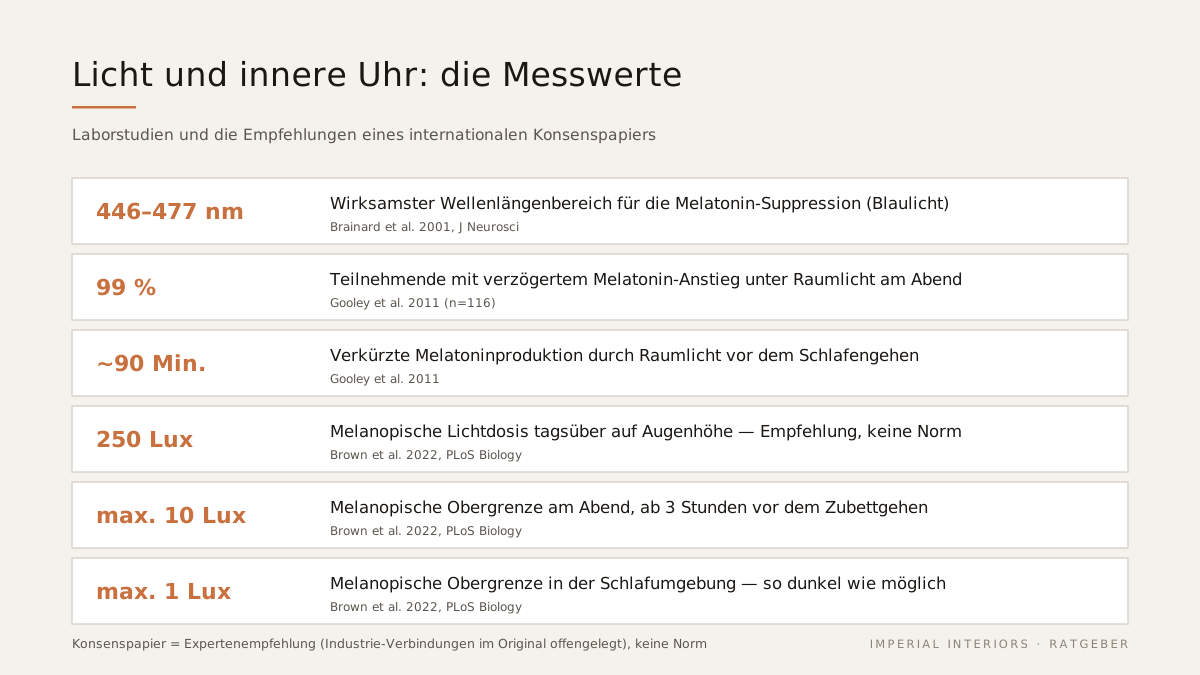
That light affects the body clock has been known for some time; which wavelengths are particularly effective at this was narrowed down in the lab by two independent action-spectrum studies. Brainard et al. (2001, n=72, Journal of Neuroscience) exposed subjects at night to monochromatic light of varying wavelength and identified the range from 446 to 477 nanometres — that is, blue light — as the most effective for light-induced melatonin suppression. A second, independent study by Thapan, Arendt and Skene (2001, n=22, Journal of Physiology) confirmed this short-wavelength sensitivity and found a peak sensitivity at around 459 nanometres. Both studies point to a distinct circadian photopigment in the eye, independent of the visual photoreceptors.
Besides wavelength, timing also matters. A phase-response-curve study by Khalsa, Jewett, Cajochen and Czeisler (2003, n=21) shows the underlying principle: if bright light reaches the eye before the body's core-temperature minimum has been reached, the body clock shifts later — a pattern typical of late evening light. Light after that point shifts the body clock earlier, as is typical of morning light. However, the study used extremely bright laboratory light of around 5000 to 10000 lux, considerably brighter than typical home lighting, and so cannot be directly applied to everyday light.
What studies show about evening light and screens
Closer to everyday life is a controlled study by Gooley et al. (2011, n=116, healthy adults aged 18 to 30). Compared with dim light of less than 3 lux, ordinary room light of less than 200 lux in the 8 hours before bedtime delayed the evening melatonin rise in 99 percent of participants and shortened the duration of melatonin production by around 90 minutes. Where room light continued during the usual sleep period, melatonin levels fell by more than half in 85 percent of the measurements. On the health implications, the study authors themselves are cautious: chronic evening light exposure disrupts melatonin signalling and could therefore potentially also affect sleep, thermoregulation, blood pressure and glucose metabolism — explicitly framed as a hypothesis, not as a causal chain established by this study. What was measured, exclusively, was melatonin, not sleep quality, blood pressure or blood glucose.
Screens were also examined. In a study by Cajochen et al. (2011, n=13, exclusively young men), 5 hours of evening screen use on an LED screen with a higher blue-light content (464 nanometres, more than double the emission of a non-LED screen at comparable image quality) suppressed the evening melatonin rise as well as subjective and objective sleepiness more strongly than the comparison screen. At the same time, in the same study, cognitive performance — attention, working memory and declarative memory — was significantly better under the LED screen: so the picture is not one-sidedly negative.
A further controlled crossover study by Chang, Aeschbach, Duffy and Czeisler (2015, n=12) found the same pattern for e-book readers: 4 hours of reading on the self-illuminated device before bedtime was associated, compared with a printed book, with a longer time to fall asleep, lower melatonin release and reduced alertness the following morning. How lighting in the home can be planned overall — from lumens and kelvin to evening lighting — is covered in more detail in our guide to lighting design at home.
Melanopic light dose: recommendations from an international panel of experts
From findings such as these, an international consensus paper by around 20 expert authors from chronobiology and sleep medicine has derived light levels (Brown et al. 2022, PLoS Biology, produced as part of the 2nd International Workshop on Circadian and Sleep Health). Important for context: this is an expert consensus paper based on existing laboratory data in healthy adults aged 18 to 55 — not a randomised study of its own, and not a binding standard. In the interest of transparency: several authors of the consensus paper disclose commercial ties to the lighting and pharmaceutical industries in the original paper — one more reason to read these figures as expert advice rather than a neutral requirement.
It is worth taking a closer look at the unit of measurement here: the melanopic light dose (melanopic EDI) is a specifically calculated quantity for the effectiveness of light on the body clock — it is not the same as ordinary room brightness in photopic lux, as printed on light-bulb packaging. According to the same consensus paper, many typical warm-white household LEDs at 2700 to 3000 kelvin already reach the recommended evening ceiling of 10 lux melanopic light dose at an illuminance of around 30 lux, because their blue-light content is inherently low.
- Daytime: at least 250 lux melanopic light dose at eye level, from daylight where possible
- Evening, starting at least 3 hours before bedtime: no more than 10 lux melanopic light dose, with a spectrum as low in blue light as possible
- Sleep environment: no more than 1 lux melanopic light dose — the room as dark as possible
Limits of the research — and what this could mean for your own home
For all its detail, gaps remain. None of the referenced studies measures hard health endpoints such as long-term sleep quality or cardiovascular and metabolic disease in relation to evening light — what was collected, exclusively, was melatonin and subjective and objective sleepiness as surrogate measures. No study has directly measured actual home light fittings, floor lamps, bedside lights or dimmable lighting systems; applying the melanopic thresholds to real living situations remains an extrapolation by the consensus-paper authors, not a measurement taken in an actual living room or bedroom. And: all the referenced studies examine healthy, predominantly young adults under laboratory conditions — none of the data named here covers older people, children and adolescents, or people with diagnosed sleep disorders.
For your own living situation, this means: the expert panel's recommendations — bright days, dimmed and as low-blue-light as possible in the evening, a dark bedroom — are a plausible steer from the current state of research, not a guaranteed recipe and no substitute for trying it out for yourself. Anyone planning bedroom lighting afresh can work through these points — daytime brightness, dimmed, low-blue evening light, as dark a room as possible — using concrete lighting set-ups in our showroom in Zurich. A consultation is no substitute for a study, but it does help with putting this into practice.
Frequently asked questions
What is circadian light, and how is it linked to the sleep rhythm?
The body clock runs on its own in the rhythm of a day and is synchronised chiefly by light taken in through the eyes. Two independent action-spectrum studies (Brainard et al. 2001, n=72; Thapan, Arendt & Skene 2001, n=22) show that short-wavelength, bluish light in the range of around 446 to 477 and 459 nanometres respectively is particularly effective for this — pointing to a distinct circadian photopigment in the eye, independent of the visual photoreceptors.
From what point, and how strongly, does evening light affect melatonin production?
According to a controlled study by Gooley et al. (2011, n=116, healthy adults aged 18 to 30), ordinary room light of less than 200 lux in the 8 hours before bedtime delayed the melatonin rise in 99 percent of participants and shortened melatonin production by around 90 minutes. Where the light continued during the usual sleep period, melatonin levels fell by more than half in 85 percent of the measurements. The study was conducted under laboratory conditions in young, healthy adults.
Is screen light before bedtime fundamentally a problem?
Not clearly. A study by Cajochen et al. (2011, n=13, exclusively young men) found that an LED screen with a higher blue-light content suppressed the evening melatonin rise and sleepiness more strongly than a comparison screen — at the same time, in the same study, cognitive performance in attention, working memory and declarative memory was significantly better under the LED screen. A further study (Chang et al. 2015, n=12) found that, compared with printed books, self-illuminated e-book readers were associated with a longer time to fall asleep and lower melatonin release. Both studies have very small samples.
What light levels do experts recommend for daytime, evening and the bedroom?
An international consensus paper by around 20 expert authors (Brown et al. 2022, PLoS Biology) recommends at least 250 lux melanopic light dose during the day, no more than 10 lux from 3 hours before bedtime in the evening, and no more than 1 lux for the sleep environment — each measured at eye level. This melanopic light dose is not the same as the ordinary room brightness in lux printed on a light-bulb package. It is an expert recommendation based on existing laboratory data, not a binding standard.
Who do these study findings apply to — and where are the limits?
All the studies cited here were conducted under laboratory conditions in healthy, predominantly young adults aged 18 to 55, some with very small samples (n=12 to n=116). None of the data named covers older people, children and adolescents, or people with diagnosed sleep disorders. Nor were any actual home light fittings or lighting systems directly measured — applying the recommendations to real living situations remains an extrapolation.
Sources & studies
The factual statements in this article are based on the following sources — each framed in the text as a study, testing institute, official figure, convention or manufacturer information:
Note: This article provides general knowledge and does not replace medical advice. Persistent complaints should be clarified by a doctor.
Prefer personal advice?
Initial consultation, first home visit and initial concept are free and non-binding. Try our beds any time in the showroom at Nüschelerstrasse 30, Zurich.