
Sleep Tourism: The Hotel Bed Feeling at Home
Travellers are increasingly booking with sleep quality in mind, and hotels advertise pillow menus, blackout curtains and soundproofing. This article looks at what research and industry data actually show — and what can be drawn from it for your own bedroom.
Sleep tourism: a market assessment, not a health promise
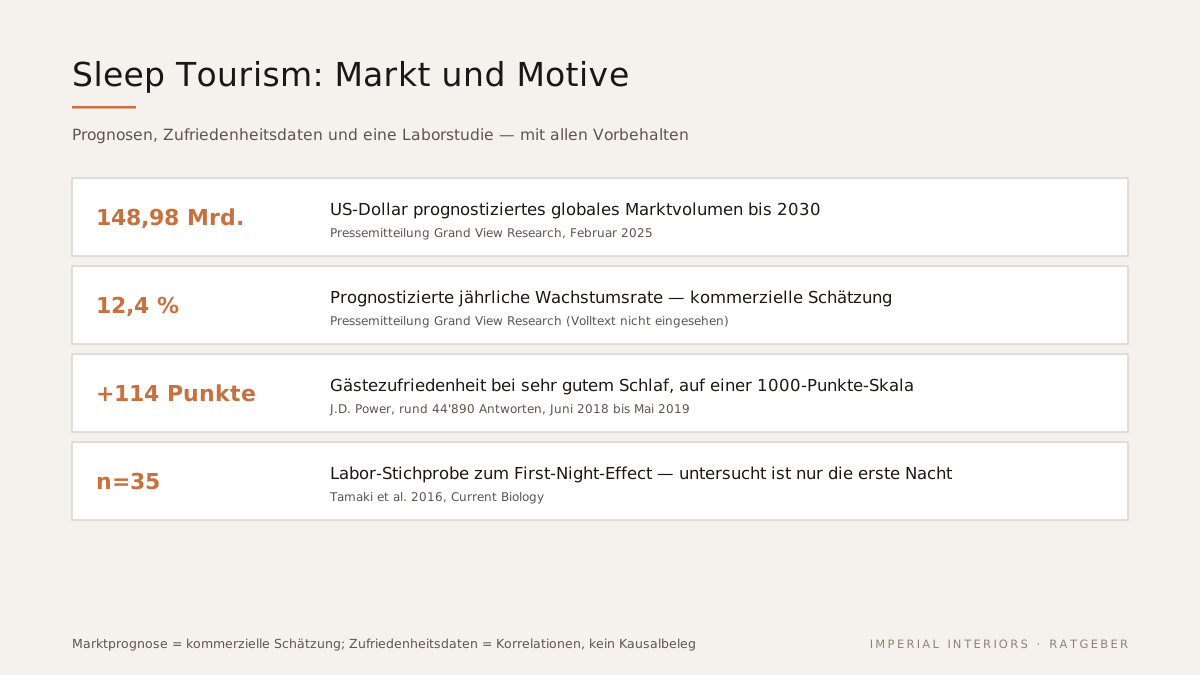
The term «Sleep Tourism» describes travel in which good sleep is the central focus — from pillow menus to specially equipped rooms. Market researcher Grand View Research estimates, in a press release from February 2025, that the global sleep-tourism market will grow to 148.98 billion US dollars by 2030, at an annual growth rate of 12.4 percent between 2025 and 2030. Figures like these are a market estimate from a commercial market-research firm, not an official or scientific survey; the full, paywalled report with the underlying methodology was not available to us. The wellness industry association Global Wellness Institute — explicitly not a medical or scientific professional body — describes, in a blog post from March 2026, offerings within this trend that include daylight-calibrated lighting systems, soundproofed rooms, guided bedtime rituals, sleep-tracking consultations and specially designed bedding. Both sources describe a market observation, not a proven effect: whether a room with these features actually leads to better sleep is not established by this. For travellers, this means: anyone specifically looking for «sleep-friendly» offerings will, according to these sources, find a growing but inconsistent market with no fixed criteria — not a validated, uniformly defined category. The growth figures cited also refer exclusively to the global market; the sources contain no specific figures for Switzerland or German-speaking countries.
The restless first night: what research shows about the first-night effect
That the first night in a new place is often more restless than the following ones is known as the «first-night effect». A study by Tamaki and colleagues (2016, Current Biology) in 35 young, healthy subjects shows a possible mechanism behind it: in the first of two sleep sessions in the lab — the sessions were around a week apart — one hemisphere of the brain remained measurably more awake than the other, acting as a kind of «night watch». This imbalance in sleep depth correlated with time to fall asleep and was no longer detectable in the second session at the same location. In the study, the more wakeful hemisphere also reacted more strongly to unexpected acoustic stimuli and triggered faster arousal responses; the authors interpret this as an evolutionary survival mechanism in an unfamiliar environment. Important for context: the study took place exclusively in the sleep laboratory, using polysomnography, EEG, MEG and MRI — not in an actual hotel setting — and only the first slow-wave sleep episode was measured. The study's co-author herself acknowledges, in a Brown University press release dated 21 April 2016, that it remains an open question whether the more wakeful hemisphere stays awake all night or shifts over the course of the night. The same press release frames the first-night effect as a familiar nuisance for business travellers and names the hotel as a typical setting for it — a framing from the press office, not part of the study conducted in the lab itself. That restless sleep during a single hotel night is therefore harmful to health cannot be derived from the study; what was measured, exclusively, was brain activity and arousal responses in the lab, not health endpoints. Nothing can be derived from the data about several consecutive travel nights either, since the study compared only two individual sessions around a week apart, not a series of nights in the same place.
What actually helps hotel guests sleep, according to surveys
How strongly sleep quality shapes hotel guest satisfaction is shown by a large North American guest-satisfaction study by J.D. Power, with around 44'890 responses from the survey period June 2018 to May 2019, cited in the trade magazine LODGING. When guests experienced better-than-expected sleep quality, their overall satisfaction was, on average, 114 points higher on a 1000-point scale — though only 29 percent of respondents reported such an experience at all. The same study names bed comfort, room quietness, pillow quality, room temperature and bedding as the strongest influences on perceived sleep quality; additional extras such as white-noise machines, earplugs and bathrobes were associated with higher satisfaction scores. Important for context: this is a large-scale consumer survey by a market-research firm, not an independently controlled efficacy study — it measures what guests report in hindsight, not what changes physiologically in a controlled comparison. In addition, the survey dates from 2019, before the pandemic — to be read as a large but older reference study, not as a current trend figure.
- Bed comfort
- Room quietness
- Pillow comfort and quality
- Room temperature
- Quality of bedding
Blackout curtains, pillow menus, soundproofing: not yet an industry standard
The Grand View Research press release (February 2025) describes individual luxury hotels offering extras such as soundproofed rooms, weighted blankets and a choice of pillows — explicitly framed as an observation at individual properties, not as an industry standard. RAND researcher Wendy Troxel reaches a similar assessment in a commentary published in 2025: high-quality mattresses, functional blackout curtains, soundproofing and thoughtful lighting are being introduced at some properties, but remain mostly confined to upmarket establishments, often marketed as separate wellness offerings. The RAND commentator explicitly frames this development as an emerging shift, not a completed state: individual properties are said to be following suit, but no industry-wide benchmark exists. In the Fortune Well section of the business magazine Fortune, the same trend is described from the guest's perspective: travellers are said to be increasingly scaling back packed itineraries in favour of pillow menus and earlier bedtimes. Harvard sleep researcher Rebecca Robbins is quoted there with the assessment that guests increasingly value sleeping well while travelling — this, too, is a piece of journalistic framing with an expert quote, not a survey of its own with a stated sample size. For your own travel planning, this means: assuming a particular room feature as a given is not justified according to these sources — it remains a question for the individual property, not the industry as a whole.
The hotel feeling at home: what guests themselves say matters
The J.D. Power figures from the previous section at least give a sense of which factors go together with more highly rated sleep quality: bed comfort, quietness in the room, pillow quality, room temperature and bedding. These are correlations from a satisfaction survey, not evidence that these factors can be replicated at home one to one, or that a specific product measurably changes sleep — but they are the points guests themselves rank as important. Anyone who wants to test this in their own bedroom can do so at leisure in our showroom on Nüschelerstrasse in Zurich: bed, mattress firmness and pillows can be tried side by side there, including items from our range with DUXIANA, NUVOSETTE and Flou. A consultation is no substitute for a study — but it does make your own sleeping position the starting point rather than an afterthought.
Frequently asked questions
What is the first-night effect, and what causes it according to research?
The first-night effect refers to the often more restless first night spent in a new place. A study by Tamaki and colleagues (2016, Current Biology) in 35 young, healthy subjects in the sleep lab shows that one hemisphere of the brain remains more awake than the other — this imbalance correlated with time to fall asleep and was no longer detectable in a second session at the same location. The study took place exclusively in the lab, with a small sample and only two sessions; an actual hotel setting or several consecutive nights were not examined.
How large is the global sleep-tourism market according to current estimates?
Market researcher Grand View Research put a figure on the global sleep-tourism market in a press release from February 2025, estimating a value of 148.98 billion US dollars by 2030, at an annual growth rate of 12.4 percent between 2025 and 2030. This is an estimate from a commercial market-research firm, not an official statistic; we did not review the methodology of the full, paywalled report.
What do hotel guests value most about their sleep, according to surveys?
According to the J.D. Power guest-satisfaction study, with around 44'890 responses (survey period June 2018 to May 2019), bed comfort, room quietness, pillow quality, room temperature and bedding are the strongest influences on perceived sleep quality. When guests experienced better-than-expected sleep quality, their overall satisfaction was, on average, 114 points higher on a 1000-point scale — though only 29 percent of respondents reported such an experience.
Has sleep-friendly room equipment now become a hotel standard?
No, not according to the available sources. Both the Grand View Research press release and a commentary by RAND researcher Wendy Troxel explicitly describe features such as blackout curtains, soundproofing, weighted blankets or pillow menus as offerings at individual, mostly upmarket properties — not as an industry-wide standard.
Can the hotel bed feeling be recreated at home?
There is no evidence for this in the sense of a scientific efficacy study — no data exists for that. The J.D. Power survey does, however, show which factors hotel guests themselves associate with more highly rated sleep quality: bed comfort, quietness, pillow quality, room temperature and bedding. These points can be tested in your own bedroom, for instance by trying beds in our showroom in Zurich.
Sources & studies
The factual statements in this article are based on the following sources — each framed in the text as a study, testing institute, official figure, convention or manufacturer information:
- Tamaki M, Bang JW, Watanabe T, Sasaki Y (2016): Night Watch in One Brain Hemisphere during Sleep Associated with the First-Night Effect in Humans. Current Biology 26(9), 1190-1194
- Tamaki et al. (2016), Volltext PMC4864126
- Brown University News: 'Asleep somewhere new, one brain hemisphere keeps watch', 21.04.2016
- Grand View Research: 'Sleep Tourism Market Size To Reach $148.98 Billion By 2030' (Pressemitteilung, Februar 2025)
- Fortune Well: 'Sleep tourism' (Artikel vom 13.01.2024), Zitat Rebecca Robbins, Harvard Medical School Division of Sleep Medicine
- Global Wellness Institute: 'Sleep Initiative Trends for 2026' (Blogbeitrag, 30.03.2026)
- Wendy M. Troxel (RAND), 'The Missing Star in Your Hotel Review? Sleep Quality', RAND Commentary, 13.08.2025
- J.D. Power 2019 North America Hotel Guest Satisfaction Index Study, zitiert in LODGING Magazine, 24.07.2019
Note: This article provides general knowledge and does not replace medical advice. Persistent complaints should be clarified by a doctor.
Prefer personal advice?
Initial consultation, first home visit and initial concept are free and non-binding. Try our beds any time in the showroom at Nüschelerstrasse 30, Zurich.