
Memory Foam or Innerspring? What's Proven — and What Isn't
No system wins across the board: what actually matters, research sorts by firmness and fit, not by material. The documented difference lies in sleep climate: according to Stiftung Warentest, pocket springs run on the cooler side with good moisture transport, while foam runs warmer and benefits those who feel the cold. For viscoelastic foam, the institute found no laboratory advantages in support, pressure distribution or lying comfort — but it also names foam's proven strengths. Disclosure upfront: our range is innerspring-based — which is why every claim in this article carries its source.
The short answer: no system wins across the board
Choosing between memory foam and innerspring isn't choosing a winner, but a behaviour. The most sober statement on this comes from Stiftung Warentest. On viscoelastic foam — the material behind the memory effect — the institute states: «In terms of support properties, pressure distribution and lying comfort, we could not identify any advantages of viscoelastic foam mattresses in the laboratory.» That is a laboratory finding from an independent institute about a material class — not a statement about any particular brand, and not a verdict that memory foam achieves nothing. In fact, the same institute names foam's proven strengths in the same overview: viscoelastic foam mattresses «adapt to the sleeper's body shape» and «thereby feel cuddly», foam «has good thermal insulation, beneficial for people who feel the cold easily», and foam mattresses are «generally easier to lift and turn than latex and innerspring» (Stiftung Warentest, Matratzentypen im Überblick, 01.09.2025).
What actually determines sleep comfort and spinal alignment, research sorts not by material class anyway, but by firmness and fit — more on that below. And it isn't just two systems in the race: Stiftung Warentest lists latex as a third. Latex reportedly offers a «particularly cuddly lying feel», is «usually especially durable» and «recommendable if you feel the cold easily, and for adjustable slatted frames», but is «on average more expensive than foam and innerspring», harder to turn, and «rather unsuitable for people who sweat heavily».
A disclosure of our own, right at the start: we are a bed retailer with an innerspring-based range. Imperial Interiors carries DUXIANA with multi-layer spring systems (from CHF 5'300), our own boxspring brand NUVOSETTE (from CHF 3'900, NUVOSETTE mattresses from CHF 2'800), King Koil Reserve Luxury (from CHF 3'500; all entry prices incl. VAT, as listed on imperial-interiors.com/de/betten), as well as individual slatted-frame beds with innerspring mattresses from Flou. In practice, we carry pure foam mattresses only in sofa beds. That is exactly why every statement about memory foam in this article carries its source in the text — so you can tell where we are reporting and where we are interpreting. Literal quotes from German sources are rendered here in Swiss spelling and Swiss number formatting.
Memory foam: where the material comes from and what it does
Memory foam is viscoelastic foam: it responds to pressure and temperature and moulds a hollow rather than springing straight back. ÖKO-TEST describes this in factual terms: «It reacts to weight and body heat. The body sinks in at the pressure points, the mattress adapts to the body's contours. However, it reacts rather sluggishly to movement.» Both halves of this quote belong together — cuddliness and sluggishness when turning over are the same material property, experienced once as an advantage and once as a drawback.
The NASA origin is not a legend, but it belongs to the material class, not to any single company. NASA documents in its official publication Spinoff 2005 that Charles Yost developed the material in 1966 on a NASA contract via the Stencel Aero Engineering Corporation, with the aim of «improvement of airline seating for crash and vibration protection». It is described as an «open-cell, polymeric ‹memory› foam material with unusual viscoelastic properties», initially called «slow spring back foam», which «flowed to match the contour of the body pressing against it and returned to its original shape once the pressure was removed». In 1969, Yost founded Dynamic Systems, Inc. and marketed the technology as «temper foam».
How individual manufacturers build on this is a manufacturer's claim — and is labelled as such here too. TEMPUR — a brand not in our range; we mention it because it shaped the material — states on its Swiss materials page that TEMPUR material traces back to «a technology that was first developed by NASA scientists and then used aboard the Space Shuttles»; the material «responds to your body temperature and actively adapts to your body shape», with «billions of highly sensitive cells absorbing the pressure and evenly distributing the shape and weight of your body» (according to the manufacturer, ch.tempur.com). On motion isolation, the same manufacturer states that the material isolates motion «up to 10-times better than a non-viscoelastic foam, with less than 2 % motion transfer». The reference point matters here: according to the manufacturer, the comparison is with non-viscoelastic foam, not with innerspring. And the label «Certified Space Technologie™» (the spelling used on the German-language TEMPUR page) comes, according to TEMPUR, from a certification programme run by the Space Foundation, which is meant to verify whether «your product directly uses technologies originally developed for use in space or in a space-related way»; the brand is «used under licence». The Space Foundation is a non-profit organisation, not NASA.
Central to this comparison: foam is not all the same. On density as a quality measure for foam, ÖKO-TEST names 45 to 55 kg/m³ as optimal; the RAL quality mark, according to the same source, sets the minimum standard at 35 kg/m³ («The higher the density, the more elastic, durable and load-bearing the material»). Whether these figures carry over to viscoelastic foam, the source does not say. Cold foam is, according to ÖKO-TEST, «thanks to its irregular, coarse pore structure» breathable and considerably more elastic than polyurethane flexible foams. So when someone says «foam mattress», they often mean two quite different materials.
Innerspring: not every innerspring provides point elasticity
The most common shortcut in this comparison is to say innerspring supports evenly across the surface while foam supports at each individual point. That's only true of simple innerspring systems. ÖKO-TEST treats the two constructions separately: innerspring mattresses, it says, support «the sleeper's body only across the surface and not with point elasticity», whereas with pocket springs «only the loaded springs give way» — hence their high point elasticity. As a minimum spring count for a 90 × 200 cm mattress, ÖKO-TEST names 400 springs for simple innerspring mattresses and 460 springs for pocket springs; according to the same source, there are also very high-quality models with more than 1'000 springs. So anyone comparing innerspring with memory foam first needs to know which kind of innerspring they are looking at.
On climate, Stiftung Warentest credits pocket springs with «good moisture transport» and calls them «therefore often well suited to people who sweat heavily». On warmth, it states: «Low thermal insulation and therefore well suited to people who quickly feel too warm» as well as «Rather cool. Those who feel the cold easily lie warmer on foam and latex.» That one sentence is the most honest in the entire topic, because it names an advantage and a drawback in a single breath — depending on who is lying on it.
The price for that is weight. Innerspring, according to Stiftung Warentest, is «on average lighter than latex but heavier than foam; lifting it can sometimes be tiresome». Anyone who regularly turns the mattress themselves or moves house often will feel that in everyday life.
How individual manufacturers solve this is, again, a manufacturer's claim — including for the brand we carry ourselves. DUXIANA describes its continuous spring system as a «precise network of interlocking high-tensile steel springs»; on ventilation, it states: «The spaces around the coils allow our beds to breathe, shuttling body heat out of the mattress» (manufacturer's claims, duxiana.com). That is a manufacturer's claim and does not substitute for an independent test. What can be relied on here is Stiftung Warentest's statement about the material class — not the wording of any single supplier, including our own.
Warmth and moisture: what's proven — and where the evidence stops
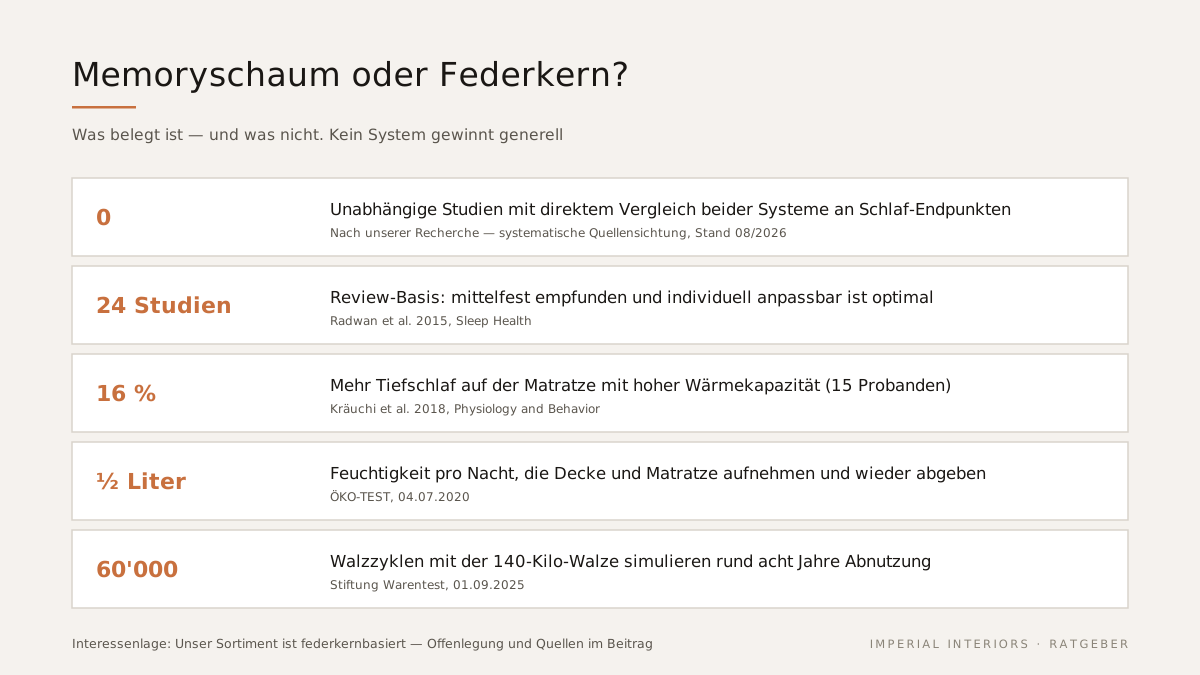
The documented difference between the two systems lies in climate, not in support. The starting point is a figure from ÖKO-TEST: «Every sleeper loses an average of about half a litre of moisture per night, which is absorbed and released not only by the duvet but also by the mattress.» Why this matters is shown by sleep research. Okamoto-Mizuno and Mizuno note in their review that temperature and relative humidity in bed during normal sleep are «generally maintained around 32 °C to 34 °C, 40 % to 60 % relative humidity»; heat exposure increases wakefulness and reduces slow-wave and REM sleep, and humid heat intensifies the effect further. This is where Stiftung Warentest's classification comes from. Foam has good thermal insulation, beneficial for people who feel the cold easily, but is rather unsuitable for people who quickly feel too warm and who sweat heavily. The institute also calls viscoelastic foam «unsuitable» for people who sweat heavily, and adds a point that becomes practical in Swiss bedrooms: «rather poor for cool rooms: in cold conditions, viscoelastic foam often hardens into a rigid shell». Anyone sleeping with the window open or in a barely heated room should know this before buying. It isn't a material weakness, but the flip side of exactly the temperature-dependence that produces the memory effect. That thermal behaviour is measurably relevant to sleep at all is shown by the sleep laboratory. Kräuchi and colleagues compared, in 2018, in a randomised single-blind crossover with 15 healthy young men, a mattress with high thermal capacity against one with low thermal capacity: slow-wave sleep rose selectively by 16 % (p<0.05), subjective sleep quality and sleep stability improved, core body temperature dropped more (by up to −0.28 °C), and the rise in mattress surface temperature was delayed (maximum difference 6.12 °C). What matters is what this study does not show: mattresses of different thermal capacity were compared — not innerspring versus memory foam. The inference from a mattress's thermal capacity to a specific mattress system is not supported by evidence, and we do not draw it. All that is permissible is the general statement: how a mattress absorbs and releases heat is measurably relevant to sleep. That comes with the study's limits — 15 participants, exclusively young men. And this is where the evidence runs out sooner than one might expect. The biomechanical review by Wong and colleagues (2019) explicitly excludes temperature and moisture — studies examining only these variables were excluded from the analysis; memory foam is also not evaluated separately in it. Independent research currently provides no reliable figure for a direct climate comparison of the two systems.
What the research actually sorts by: firmness and fit, not material
Based on our research, there is no independent study that tests memory foam and innerspring directly against each other on sleep endpoints. That is the most important sentence in this article — and the reason why no system is declared the winner here. What does exist is a well-documented ordering by a different variable: firmness and fit.
Radwan and colleagues, in a 2015 systematic review, analysed 24 controlled studies and concluded that a bed subjectively perceived as medium-firm and individually adjustable is optimal for sleep comfort, sleep quality and spinal alignment; the authors describe the evidence on optimal mattress temperature as insufficient. Caggiari and colleagues independently confirmed this in 2021: «a medium-firm mattress promotes comfort, sleep quality and rachis alignment», while on mattresses that are too soft, «hips and shoulders sink too much into the mattress, leading to column misalignment».
How strongly firmness affects this was measured by Hong and colleagues in 2022 on three mattresses with Indentation Load Deflection of 20, 42 and 120 lbs. Compared with the medium mattress, on the soft one head clearance increased by 30.5 ± 15.9 mm, cervical lordosis clearance by 26.7 ± 14.9 mm, and peak intervertebral disc stress by 49 %. On the firm mattress, lumbar lordosis clearance decreased by 10.6 ± 6.8 mm; disc stress did not increase significantly, but contact pressure did. Both extremes therefore have their drawbacks — and neither is a matter of material. These figures are measurements from a laboratory study, not diagnostic or therapeutic claims.
That foam can perform well in controlled studies is shown by an independent, peer-reviewed study. Bergholdt and colleagues, in 2008, in a randomised-stratified, single-blind parallel-group study with 160 patients with chronic back pain, compared three sleep systems over one month: a waterbed, a body-contouring foam mattress from the brand Tempur, and a hard futon mattress. The waterbed and the foam mattress influenced symptoms, function and sleep more positively than the hard mattress, «but the differences were small»; no relevant difference was found between the waterbed and the foam mattress. The brand is named here because the study names it. And the limitations belong here too: a four-week duration, exclusively patients with chronic back pain, a hard futon mattress as the comparator — and the authors themselves consider the differences small.
Finally, caution around metrics is urged by the review from Wong and colleagues (2019): interface pressure alone as the main indicator is disputed («the validity of this approach remains controversial»), and mattresses «with over-concentrated or over-even pressure distribution produced low satisfaction scores». The required mattress stiffness, they note, depends on body build and spinal curvature; subjective comfort ratings are also easily influenced, because «comfort» is defined very differently.
Firmness grade, standard and durability — what the labels actually tell you
The firmness grade on the label is not a shared language. ÖKO-TEST states: «Mattresses are offered in three to four firmness grades. In doing so, the firmness grades differ from manufacturer to manufacturer.» So H2 from one brand need not be H2 from another. Independent sources support no more than that — and we claim no more than that either.
The European standard EN 1957 (2012-12 edition; cited here from the Austrian version ÖNORM EN 1957) goes even further. It sets out the test methods for determining the functional properties of mattresses and fully assembled beds — waterbeds, air mattresses and children's beds are excluded — and it states explicitly that the measured firmness has no bearing on the comfort and/or quality of a mattress or a complete bed. A standard could hardly say more plainly that a label is no substitute for lying on the mattress yourself.
To put the test landscape in context: Stiftung Warentest's mattress test (as of 01.09.2025) covers 118 mattresses and weights lying properties at 35 %, durability at 25 %, comfort, cover, and health and environment at 10 % each, and handling and labelling at 5 % each. The results for individual models sit behind a paywall — so we name no test winners here, only the freely documented statements about mattress types.
On durability, the testing bodies check to different depths. Stiftung Warentest describes: «For quality durability in the continuous rolling test, we rolled a 140-kilo roller over the mattress 60'000 times. This simulates around eight years of wear.» The EU Ecolabel for bed mattresses also bases its durability testing on EN 1957, but measures the decrease in height and firmness as the difference between the initial measurements at 100 cycles and the final measurement at 30'000 cycles. Different testing depths, no contradiction. That both systems age is suggested by a measurement from the clinical setting: Bredesen, in 2020, compared new and used standard and viscoelastic hospital mattresses with 20 healthy subjects and measured mean interface pressures between 30.28 and 38.37 mmHg (p = 0.011); older standard mattresses were less comfortable and showed higher interface pressures than new standard and viscoelastic foam mattresses. That was supine position, ten minutes, a clinical context — not directly transferable to everyday private use. Incidentally, Stiftung Warentest writes the very same sentence under both innerspring and foam: «Quality partly suffers under the influence of heat, moisture and weight.»
Regulatorily, both systems sit under the same roof. Commission Decision 2014/391/EU on the EU Ecolabel for bed mattresses regulates latex foam, polyurethane foam, wires and coil springs, coconut fibres, and textile materials separately, but within the same set of criteria; for the finished mattress, emission limits apply of under 0.5 mg/m³ VOC at day 7, or alternatively under 0.2 mg/m³ at day 28. No material is therefore inherently the cleaner one from a regulatory standpoint — the figures are a reference point when buying, nothing more.
For the Swiss market, there is a dedicated test (published in November 2021): Kassensturz and K-Tipp had eight foam mattresses from well-known manufacturers under 900 francs tested, along with a latex mattress for comparison — long-term testing at TÜV Rheinland in Nuremberg, ergonomics at Ergonomie Institut München. All mattresses received «good» or «very good» for long-term durability (60'000 rolling cycles, corresponding to eight to ten years of use); clear differences, however, showed up in ergonomics. Innerspring models were not included in this test field — so it isn't suited as a system comparison, but it does indicate where the differences lie in practice: rarely in durability, mostly in fit.
Which system suits whom — and how to find out
The decision comes down to four questions, not the material: How warm do you sleep? How cool is your bedroom? How firm do you need it? And how do you handle the mattress day to day? The summary below pulls together what has been documented in this article — it does not replace trying it out yourself. Important for context: the tests cited evaluate mattress types in general; the models we carry were not the subject of these tests.
That trying it out is necessary is said by the independent bodies themselves. ÖKO-TEST advises: «Take your time, and try out every sleeping position at the furniture store.» Kassensturz and K-Tipp, at the same time, note the limit: «Of all things, what you can't see and can't feel either during a brief try-out in the shop is the most important thing – the geometry of a mattress.» Together, the two give a realistic expectation: trying a mattress reliably shows you how a system feels — warmth, how deep you sink in, how it behaves when you move. What it does not show is durability; for that, you need test reports and time.
With us, you can do both at your own pace. In the showroom at Nüschelerstrasse 30 in Zurich you can try mattresses without an appointment, Monday to Friday 10:00-19:00 and Saturdays 10:00-18:00; the initial consultation is free. As disclosed at the outset, our range is innerspring-based: DUXIANA from CHF 5'300, NUVOSETTE boxspring from CHF 3'900, NUVOSETTE mattresses from CHF 2'800, King Koil Reserve Luxury from CHF 3'500 (all incl. VAT); in practice, we carry pure foam mattresses only in sofa beds. If it becomes clear in conversation that memory foam suits you better — because you feel the cold easily, keep a warm bedroom, and are looking for a close-contouring lying feel — we will tell you so. Delivery and assembly are handled by our own team across Switzerland, usually within 48 hours; we will give you the terms for that with your quote.
- You sweat heavily at night or quickly feel too warm: that points to pocket springs — Stiftung Warentest credits them with good moisture transport and low thermal insulation — according to the institute, well suited to people who quickly feel too warm.
- You feel the cold easily: that points to foam or latex — according to Stiftung Warentest, their good thermal insulation is beneficial for people who feel the cold easily; those who feel the cold, it says, lie warmer on foam and latex.
- Your bedroom is kept cool or barely heated: viscoelastic foam, according to Stiftung Warentest, is rather poor for cool rooms — in cold conditions it often hardens into a rigid shell.
- You want a cuddly, close-contouring lying feel: that is viscoelastic foam's proven strength — according to Stiftung Warentest, the mattresses adapt to the body's shape and thereby feel cuddly. The flip side, according to ÖKO-TEST: they react rather sluggishly to movement.
- You lift and turn the mattress yourself: foam, according to Stiftung Warentest, is generally easier to lift and turn than latex and innerspring; with innerspring, the institute says, lifting can sometimes be tiresome.
- You value precise, point-by-point support: that is decided by the construction, not the material class — with pocket springs, according to ÖKO-TEST, only the loaded springs give way, while simple innerspring mattresses support evenly across the surface rather than with point elasticity.
- You're unsure about firmness: neither the firmness grade nor the standard makes the decision for you — firmness grades, according to ÖKO-TEST, differ from manufacturer to manufacturer, and according to EN 1957, the measured firmness has no bearing on comfort or quality.
Frequently asked questions
Is memory foam warmer than innerspring — and who does that benefit?
For foam in general, Stiftung Warentest says yes — and whether that's an advantage depends on you. Foam, it says, offers good thermal insulation, beneficial for people who feel the cold easily, but is rather unsuitable for people who quickly feel too warm and who sweat heavily. The same institute describes innerspring as rather cool, with low thermal insulation, and often well suited to people who sweat heavily because of its good moisture transport. So those who feel the cold lie warmer on foam and latex; those who sweat, cooler on innerspring. Based on our research, no direct, independent climate comparison of the two systems with measured values exists.
Is it true that memory foam comes from NASA?
The origin of the material is officially documented: NASA documents in Spinoff 2005 that Charles Yost developed the viscoelastic material in 1966 on a NASA contract — an «open-cell, polymeric ‹memory› foam material with unusual viscoelastic properties», initially called «slow spring back foam» and marketed from 1969 as «temper foam». This history belongs to the material class, not to any single brand. When a manufacturer says its material traces back to NASA technology, that is a manufacturer's claim: TEMPUR, for instance (a brand we do not carry), states that its own material traces back to «a technology that was first developed by NASA scientists and then used aboard the Space Shuttles». The label «Certified Space Technologie™» (the spelling used on the German-language TEMPUR page) comes, according to TEMPUR, from the Space Foundation — a non-profit organisation, not NASA — and is «used under licence».
Are there studies that clearly say which system is better?
No. Based on our research, no independent study exists that tests memory foam and innerspring directly against each other on sleep endpoints. The biomechanical review by Wong and colleagues (2019) does not evaluate memory foam separately and excludes temperature and moisture from its analysis. What is documented is an ordering by a different variable: Radwan and colleagues (2015), in a systematic review of 24 controlled studies, conclude that a bed subjectively perceived as medium-firm and individually adjustable is optimal for comfort, sleep quality and spinal alignment; Caggiari and colleagues (2021) confirm this. Stiftung Warentest could not identify any laboratory advantages for viscoelastic foam mattresses in support, pressure distribution or lying comfort. At the same time, foam can perform well in controlled studies — in Bergholdt and colleagues (2008), a body-contouring foam mattress influenced symptoms, function and sleep more positively than a hard futon mattress, «but the differences were small».
What does the H1 to H5 firmness grade actually tell you?
Less than many assume. Two things are documented. ÖKO-TEST writes: «Mattresses are offered in three to four firmness grades. In doing so, the firmness grades differ from manufacturer to manufacturer.» So a firmness grade is a claim by the respective manufacturer and is not directly comparable across brands. And the European standard EN 1957 states that the measured firmness has no bearing on the comfort and/or quality of a mattress or a complete bed. Direction instead comes from Radwan and colleagues and Caggiari and colleagues: a bed subjectively perceived as medium-firm and adjustable performs best — subjective meaning you have to feel it for yourself.
Does Imperial Interiors also carry memory foam mattresses?
In practice, only in sofa beds. Our range is innerspring-based: DUXIANA with multi-layer spring systems from CHF 5'300, our own boxspring brand NUVOSETTE from CHF 3'900 (NUVOSETTE mattresses from CHF 2'800), King Koil Reserve Luxury from CHF 3'500 (all incl. VAT), as well as individual slatted-frame beds with innerspring mattresses from Flou. We disclose this so you can properly weigh this comparison. If it becomes clear in conversation that memory foam suits you better, we will tell you so. You can try mattresses without an appointment at Nüschelerstrasse 30 in Zurich, Monday to Friday 10:00-19:00 and Saturdays 10:00-18:00; the initial consultation is free.
Sources & studies
The factual statements in this article are based on the following sources — each framed in the text as a study, testing institute, official figure, convention or manufacturer information:
- Stiftung Warentest – Matratzentypen im Überblick: Latex, Federkern, Schaum (01.09.2025)
- Stiftung Warentest – Matratzen im Test: Testumfang und Prüfmethodik (01.09.2025)
- ÖKO-TEST – Matratze kaufen: So finden Sie die richtige Matratze (04.07.2020)
- ÖNORM EN 1957 (Ausgabe 2012-12) – Betten und Matratzen, Prüfverfahren zur Bestimmung der funktionellen Eigenschaften (Normendatenbank bdb.at)
- Beschluss der Kommission 2014/391/EU – EU-Umweltzeichen für Bettmatratzen (EUR-Lex)
- NASA Spinoff 2005, Kapitel «Consumer Goods» – Herkunft des viskoelastischen «temper foam»
- TEMPUR Schweiz – Materialseite «Memory Foam» (Herstellerangaben)
- TEMPUR Schweiz – Seite «Space Foundation» (Herstellerangaben)
- DUXIANA – «The DUX Innovation» (Herstellerangaben, abgerufen 31.08.2026)
- Kräuchi K, Fattori E, Giordano A et al. (2018): Sleep on a high heat capacity mattress increases conductive body heat loss and slow wave sleep. Physiology & Behavior 185:23–30
- Okamoto-Mizuno K, Mizuno K (2012): Effects of thermal environment on sleep and circadian rhythm. Journal of Physiological Anthropology 31:14
- Bergholdt K, Fabricius RN, Bendix T (2008): Better backs by better beds? Spine 33(7):703–708
- Radwan A, Fess P, James D et al. (2015): Effect of different mattress designs on promoting sleep quality, pain reduction, and spinal alignment. Sleep Health 1(4):257–267
- Caggiari G, Talesa GR, Toro G et al. (2021): What type of mattress should be chosen to avoid back pain and improve sleep quality? Journal of Orthopaedics and Traumatology 22:51
- Wong DW, Wang Y, Lin J et al. (2019): Sleeping mattress determinants and evaluation – a biomechanical review and critique. PeerJ 7:e6364
- Hong TT, Wang Y, Wong DW et al. (2022): The Influence of Mattress Stiffness on Spinal Curvature and Intervertebral Disc Stress. Biology 11(7):1030
- Bredesen IM (2020): Interface Pressures of New and Worn Standard and Viscoelastic Hospital Mattresses. Wound Management & Prevention 66(8):26–31
- SRF Kassensturz / K-Tipp – «Für einen gesunden Schlaf: Blick unter die Bettdecke – Matratzen im Test» (16.11.2021)
Note: This article provides general knowledge and does not replace medical advice. Persistent complaints should be clarified by a doctor.
Prefer personal advice?
Initial consultation, first home visit and initial concept are free and non-binding. Try our beds any time in the showroom at Nüschelerstrasse 30, Zurich.