
Bedroom in Winter: Humidity, Ventilation and the Distance of Furniture from Cool External Walls
During the heating season, the Federal Office of Public Health (BAG) recommends, as a rule of thumb, 30 to 50 per cent relative indoor humidity, ventilating several times a day with a through-draught and 10 centimetres between furniture and external walls. An overview of the official recommendations on bedroom humidity and on furniture against cool external walls, what the studies say about ventilation, and what is not proven.
The short answer: key figures for the heating season
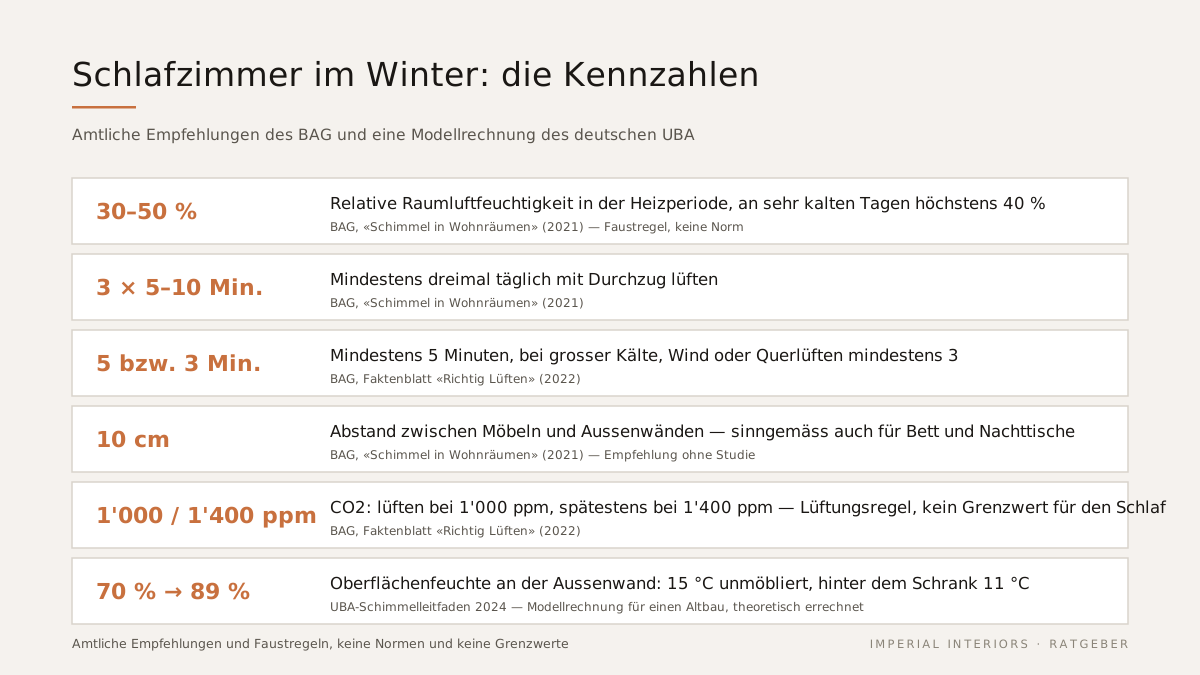
For bedroom humidity during the heating season, the Federal Office of Public Health (BAG) recommends, as a rule of thumb, 30 to 50 per cent relative indoor humidity, and no more than 40 per cent on very cold days. According to the brochure «Schimmel in Wohnräumen» (Mould in Living Spaces, 2021), rooms should be aired at least three times a day for 5 to 10 minutes with a through-draught. The fact sheet «Richtig Lüften» (Ventilating Correctly, 2022) gives at least 5 minutes, and at least 3 minutes in severe cold, in wind or when cross-ventilating. Permanent ventilation with tilted windows is to be avoided during the heating season. The BAG recommends 10 centimetres between furniture and external walls. By analogy, this also applies to the bed, bedside tables and chests of drawers. The BAG gives this distance for external walls in general; according to the German Federal Environment Agency (UBA), furniture against well-insulated external walls is generally unproblematic if ventilation is adequate. Large wardrobes are better not placed against cool external walls or in cool external-wall corners. All of these values are official recommendations and rules of thumb, not standards and not limit values. The BAG cites no study for them. This article shows what the sources support, where they complement each other and what is not proven.
Why moisture in the bedroom becomes an issue in winter
The BAG names poorly insulated external walls as a common cause of excessive moisture and mould. They cool down in the colder seasons and become damp as a result. A low room temperature can make this worse. According to the BAG web page «Korrektes Lüften und Heizen» (Correct Ventilation and Heating), bedrooms are among the problem rooms with relatively frequent moisture and mould problems. Then there is the night: when breathing and sweating, the body releases moisture into the room air, according to the German Federal Environment Agency (UBA) in its 2024 mould guideline. According to the BAG, misted-up windows are a sign of far too high a humidity. On temperature: according to the BAG, lowering the bedroom to 18 °C is unproblematic only in well-insulated and ventilated buildings. In older, poorly insulated buildings from the 1960s and 1970s, the BAG advises not delaying the start of heating and regulating to around 20 °C. This serves to prevent mould and says nothing about the ideal sleeping temperature. On that, read the article «Bedroom Temperature: Why Heat Is the Real Sleep Thief».
The rule of thumb of 30 to 50 per cent: what it is and what it is not
The BAG's 30 to 50 per cent is a rule of thumb for the room air. The BAG does not demonstrate that this range is optimal for sleep. Do not confuse it with the bed climate: for the microclimate under the duvet, our article on bedroom temperature gives 40 to 60 per cent. These are two quantities in two places. According to the UBA, a simple thermo-hygrometer is suitable for monitoring, although its readings allow only a rough estimate. The BAG advises against using humidifiers in rooms with moisture problems; the UBA names drying laundry and many houseplants in the cold season as sources of moisture that should be avoided when humidity is high. Neither body gives a separate lower limit for humidifiers. As a reason for prevention: the short description of the 2009 WHO guideline names more frequently occurring respiratory symptoms, allergies and asthma in damp indoor spaces as the most important effects and names no humidity threshold. A review article (Wolkoff 2018) describes the question as long disputed: higher humidity can improve perceived air quality and eye complaints, but mouse studies show no stronger irritation of the airways from dry air. Blanket statements such as «dry air makes you ill» cannot be derived from this.
Ventilating correctly: how often, how long, with what
According to the BAG, humidity can be reduced by ventilating more often and producing less moisture. Two BAG documents give different durations, which we do not mix. The brochure «Schimmel in Wohnräumen» (2021) gives as a rule of thumb at least three times a day for 5 to 10 minutes with windows and doors open and a through-draught; anyone who is not at home during the day can do this in the morning, on coming home and before going to bed. The fact sheet «Richtig Lüften» (2022) recommends, for rooms with window ventilation during the heating season, at least 5 minutes, and at least 3 minutes on very cold days, in wind or when cross-ventilating. For flats it names the morning, midday and the time before going to bed. Both documents recommend opening all the windows; the fact sheet specifies: open them fully. The UBA regards intensive (burst) ventilation and cross-ventilation as the methods of choice; tilted-window ventilation is markedly less effective and can strongly cool the area of the window reveal and lintel, so that condensation forms there. As a ventilation aid, the BAG names a CO2 meter and recommends ventilating at 1'000 ppm CO2, at the latest at 1'400 ppm, and ideally until the value falls below 500 ppm. This is a ventilation rule, not a limit value for sleep. Most of these devices also display temperature and relative humidity.
At night: window closed, door slightly open? BAG and studies
The BAG advises against bedroom windows left open or tilted at night, for energy reasons. It recommends airing the whole flat thoroughly in the evening before going to bed and leaving the bedroom door open at least 10 centimetres. The BAG web page adds a qualification: very low temperatures below 18 °C, or slightly reduced temperatures in houses with poor insulation, can lead to condensation on the cooler bedroom walls, especially when room doors are open. The German Federal Environment Agency, by contrast, advises keeping the doors to warmer rooms closed for bedrooms; as the reason it gives the water released by the occupants during the night. For Switzerland, this article follows the BAG recommendation, including its qualification. In two field experiments in single rooms of a student residence (Strøm-Tejsen et al. 2016, 14 and 16 people), sleep quality measured by actigraph was better at lower CO2. In 17 young adults (Mishra et al. 2018), with the window or door open, the sleep depth recorded by questionnaire and the sleep stage recorded by actigraph differed from the condition with the window and door closed. In a field trial in 29 bedrooms with an exhaust ventilation system (Fan et al. 2023), in the rooms with a clear difference in ventilation, deep sleep measured by wrist tracker was shorter with low ventilation; the authors call for larger studies. A Danish survey of 517 people (Liao et al. 2021), by contrast, found no association between the sleep quality index PSQI and ventilation behaviour. The field studies are small; we found no Swiss study.
Furniture against the external wall: 10 centimetres of distance and what lies behind it
The BAG recommends keeping 10 centimetres between furniture and external walls, because curtains and furniture restrict air circulation and can encourage mould growth. The BAG text speaks of furniture, not the bed; applying it to the bed, bedside tables and chests of drawers is by analogy. The UBA explains the mechanism: the humidity of the room air reaches behind the furniture, but the warmth does so only inadequately, so the relative humidity rises at the wall behind it. A UBA model calculation for an inadequately insulated older building (theoretically calculated, steady-state conditions) gives, at the unfurnished external wall with a surface temperature of 15 °C, a surface humidity of 70 %; behind a wardrobe at 11 °C, already 89 %; in the external corner at 6 °C, condensation. In well-insulated buildings, furniture against the external wall is generally unproblematic according to the UBA, provided ventilation is adequate. According to the UBA, built-in wardrobes should not be installed against inadequately insulated external walls without an adequate air gap towards the room. The German Federal Environment Agency recommends furnishing along internal walls in preference in the bedrooms of poorly insulated buildings. Rule of thumb from interior-design practice: if the floor plan allows, the bed stands with its headboard against an internal wall.
What remains for practice
How strongly the recommendations apply depends on the insulation of the external wall (see above). So first check what your external wall is like, and then follow these points. How a bed fits the situation in the room is something we clarify in our sleep consultation. We carry DUXIANA beds, NUVOSETTE box-spring beds and a few slatted-base beds with spring-core mattresses from Flou; we make no statements about moisture or mould depending on the bed system, because we have no reliable source for it. You can try beds out by lying on them in the showroom at Nüschelerstrasse 30 in Zurich. We plan built-in wardrobes and made-to-measure furniture in Zurich with our partners, and for interior fit-out with the Sümi joinery. For built-in wardrobes against cool external walls, we discuss rear ventilation case by case. Made-to-measure work is not on display in the showroom. The planning conversation is non-binding and takes place in the showroom or at your home, where we measure the room.
- Keep an eye on the room air during the heating season: 30 to 50 per cent as the BAG rule of thumb, no more than 40 per cent on very cold days.
- Ventilate several times a day with a through-draught, opening the windows fully (according to the BAG fact sheet) rather than keeping them permanently tilted.
- Move furniture 10 centimetres away from cool external walls (BAG recommendation, by analogy also for the bed, bedside tables and chests of drawers); do not place large wardrobes in cool external-wall corners.
- Rule of thumb: if the floor plan allows, place the bed with its headboard against an internal wall.
Frequently asked questions
What humidity is right in the bedroom in winter?
As a rule of thumb for the heating season, the BAG recommends 30 to 50 per cent relative indoor humidity, and no more than 40 per cent on very cold days. It is a recommendation for the room air, not a limit value and not a standard, and it does not concern the bed climate under the duvet. According to the UBA, a simple thermo-hygrometer allows only a rough estimate.
How much distance does the bed need from the external wall?
The BAG recommends 10 centimetres between furniture and external walls; by analogy this also applies to the bed, bedside tables and chests of drawers. Large wardrobes are better not placed against cool external walls or in cool external-wall corners. The German UBA mentions «a few centimetres» and regards furniture against external walls in well-insulated buildings as generally unproblematic.
Should the bedroom window stay tilted at night?
No, advises the BAG: bedroom windows left open or tilted at night lead to large energy losses. The BAG recommends airing the whole flat thoroughly in the evening before going to bed and leaving the bedroom door open at least 10 centimetres. At very low temperatures below 18 °C, or with slightly reduced heating in poorly insulated houses, an open door can, according to the BAG web page, lead to condensation on cool bedroom walls. The German Federal Environment Agency, by contrast, advises keeping the doors to warmer rooms closed for bedrooms, because moisture is released into the room air at night. For Switzerland, we follow the BAG recommendation with its qualification.
How often and for how long should I ventilate in winter?
The BAG brochure «Schimmel in Wohnräumen» (2021) gives as a rule of thumb at least three times a day for 5 to 10 minutes with a through-draught. The BAG fact sheet «Richtig Lüften» (2022) recommends at least 5 minutes, and at least 3 minutes on very cold days, in wind or when cross-ventilating. Both figures are official recommendations.
Sources & studies
The factual statements in this article are based on the following sources — each framed in the text as a study, testing institute, official figure, convention or manufacturer information:
- Bundesamt für Gesundheit BAG (Hrsg.), Januar 2021: Schimmel in Wohnräumen. Informationen für Bewohner, Mieter und Vermieter (Text: Claudia Vassella Brantschen), S. 10-12
- Bundesamt für Gesundheit BAG, Direktionsbereich Gesundheitsschutz, 2022: Faktenblatt «Richtig Lüften» (Text datiert 31. August 2022; auf der BAG-Seite mit Datum 2. November 2023 geführt), S. 4-5
- Bundesamt für Gesundheit BAG: Korrektes Lüften und Heizen (Webseite)
- Umweltbundesamt (Deutschland), Innenraumlufthygiene-Kommission, 2024 (Stand April 2024): Leitfaden zur Vorbeugung, Erfassung und Sanierung von Schimmelbefall in Gebäuden (Schimmelleitfaden); Bearbeiter: H.-J. Moriske, R. Szewzyk, P. Tappler, K. Valtanen
- WHO Regional Office for Europe (Hrsg.), 2009: WHO guidelines for indoor air quality: dampness and mould
- Wolkoff P, 2018: Indoor air humidity, air quality, and health - An overview. Int J Hyg Environ Health 221(3):376-390. doi 10.1016/j.ijheh.2018.01.015. PMID 29398406
- Strøm-Tejsen P, Zukowska D, Wargocki P, Wyon DP, 2016: The effects of bedroom air quality on sleep and next-day performance. Indoor Air 26(5):679-686. doi 10.1111/ina.12254. PMID 26452168
- Mishra AK, van Ruitenbeek AM, Loomans MGLC, Kort HSM, 2018: Window/door opening-mediated bedroom ventilation and its impact on sleep quality of healthy, young adults. Indoor Air 28(2):339-351. doi 10.1111/ina.12435. PMID 29164702
- Fan X, Liao C, Matsuo K, Verniers K, Laverge J, Neyrinck B, Pollet I, Fang L, Lan L, Sekhar C, Wargocki P, 2023: A single-blind field intervention study of whether increased bedroom ventilation improves sleep quality. Sci Total Environ 884:163805. doi 10.1016/j.scitotenv.2023.163805. PMID 37142023
- Liao C, Akimoto M, Bivolarova MP, Sekhar C, Laverge J, Fan X, Lan L, Wargocki P, 2021: A survey of bedroom ventilation types and the subjective sleep quality associated with them in Danish housing. Sci Total Environ 798:149209. doi 10.1016/j.scitotenv.2021.149209. PMID 34332381
Note: This article provides general knowledge and does not replace medical advice. Persistent complaints should be clarified by a doctor.
Prefer personal advice?
Initial consultation, first home visit and initial concept are free and non-binding. Try our beds any time in the showroom at Nüschelerstrasse 30, Zurich.