
Hästens or DUXIANA? Two Swedish Heritage Houses, Two Constructions
Hästens and DUX are both Swedish, both handmade — and constructively different. According to the manufacturer, Hästens works with independently acting pocket springs above a Bonnell base spring layer and fills the layers with horsehair, cotton, wool and flax. According to the manufacturer, DUX works with a continuously wound endless spring system made of Swedish spring steel and lets you change the firmness even after purchase via interchangeable Pascal cassettes. We have not found an independent, comparative test of the two systems — this article therefore names no winner, but instead sets construction, materials, adjustability, warranty and price transparency side by side, with a source given for every statement in the text. And so you know who is writing this: we carry DUXIANA. We do not carry Hästens.
The Short Answer — and Where We Stand
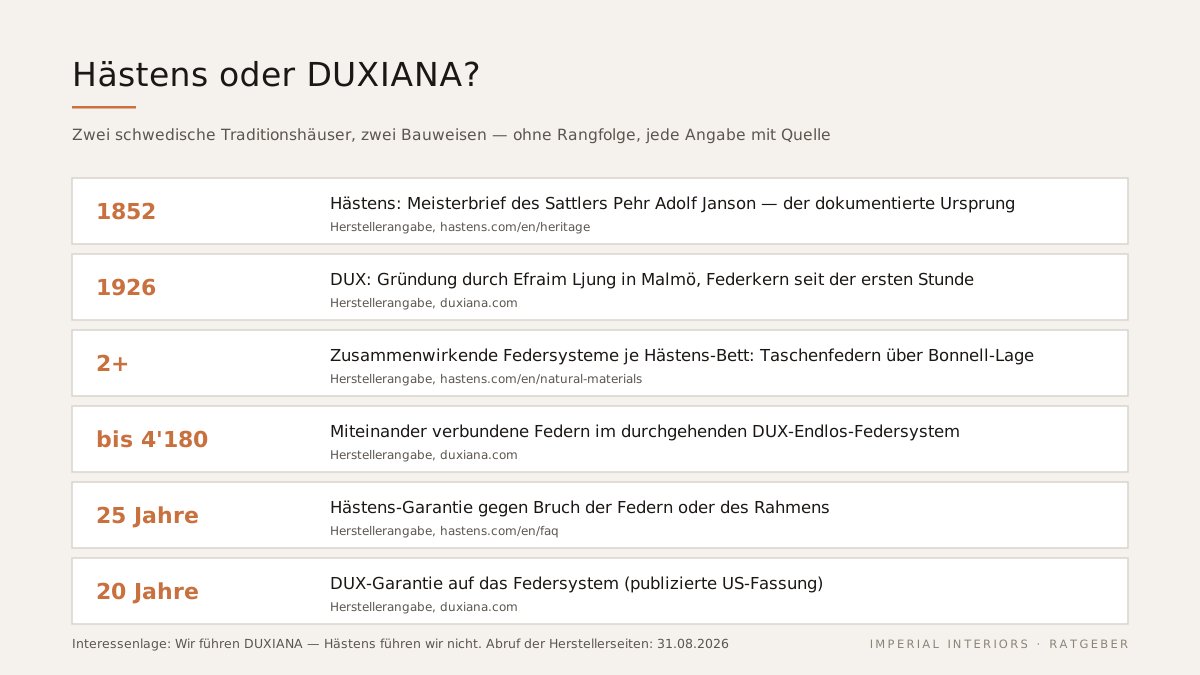
Hästens and DUX are both Swedish bed makers with a long history, and both build handcrafted spring beds in the very top price segment. The demonstrable difference lies in the spring construction. Hästens describes its beds as having two or more spring systems working together: soft pocket springs near the surface that act independently of one another, with firmer springs beneath them in a Bonnell coil system; the layers are filled with horsehair, cotton, wool and flax (hastens.com, «Natural materials» page). DUXIANA describes DUX as having a continuously wound endless spring system made of high-tensile Swedish steel wire, in which the springs are connected to one another and work together as a net, complemented by the Pascal system of interchangeable spring cassettes that lets the firmness be changed even after purchase (duxiana.com). Both are established, mature constructions with different response characteristics. We have not found an independent, comparative test of the two systems — not from Stiftung Warentest, nor from K-Tipp or Kassensturz. This article therefore contains no ranking and no test winner. What it does contain is construction, materials, adjustability, warranty and price transparency set out side by side, so you can decide for yourself. On our own stake in this, openly and right at the start: Imperial Interiors carries DUXIANA in Zurich. We do not carry Hästens. Precisely for that reason, we keep strictly in this text to what the two manufacturers publish themselves, and give the source for every statement about Hästens — so that you can look it up yourself rather than having to take our word for it.
Two Origins: Saddlery Craft From 1852, Spring Core From 1926
Hästens traces its origin to 22 March 1852: on that day, Pehr Adolf Janson received his master saddler's certificate from the King of Sweden, and at the time a saddler's duties also included making horsehair mattresses (company history on hastens.com). The date therefore marks a master craftsman's diploma, not a company founding in the modern sense. The company states it is family-owned in its sixth generation; the third generation decided in 1917 to focus entirely on beds, and in 1988 Jan Ryde, the fifth generation, took over management. The company has been headquartered in Köping, Västmanland, since the mid-1920s; the factory there was designed by architect Ralph Erskine and extended by him in 1998. In 1952, Hästens was appointed Royal Swedish Purveyor to the Court by King Gustaf VI Adolf; the appointment was renewed in 1995 by King Carl XVI Gustaf, and it must be renewed anew at every change of monarch. This is an appointment and a piece of company history, not a quality judgement on the product. According to the manufacturer, the logo has been registered as a trademark in Sweden since 13 January 1935, and the blue-and-white check pattern «Blue Check», by which many people recognise the brand, was designed in 1978 by Jack Ryde (all details up to here: company history on hastens.com, accessed 28.08.2026). A report from the factory in Köping puts annual production at around 17'000 beds and describes how the mattresses are made only to customer order, and that hand-tufting one side of a mattress takes six months to a year to learn (Whitewall, 2019 — the figures reflect the situation at that time). DUX dates back to 1926: the Swedish chocolate manufacturer Efraim Ljung began producing spring mattresses in Malmö. According to the company's own account, the trigger was a hotel night in Chicago in 1924, during which he cut a mattress open and discovered the springs inside. DUX states it has been one hundred percent family-owned for a hundred years and is today run in the fourth generation by descendants of Efraim Ljung. The company states it has a presence in more than thirty countries; its US business has existed since 1976/1977, with a showroom and office in New York, and the DUXIANA concept was added around ten years later in Europe, the United Kingdom and the US. One point belongs here for the sake of honesty: for Hästens, the manufacturing in Köping is documented by the manufacturer and is also described this way outside the manufacturer's own site (Wikipedia article «Hästens», accessed 28.08.2026). For DUX, the manufacturer's own pages document the brand's Swedish origin, its beginnings in Malmö, and the use of high-tensile Swedish steel; duxiana.com and dux.se do not name a current manufacturing location. We therefore make no claim about one.
The Construction: Independent Pocket Springs Versus a Connected Endless Spring
The central difference in construction can be stated in one sentence: at Hästens, the springs near the surface act independently of one another; at DUX, they act connected to one another. On its «Natural materials» page, Hästens states that all Hästens beds contain two or more spring systems working together — soft pocket springs near the surface that each respond individually, with firmer springs beneath them as a Bonnell coil system; according to the manufacturer, the springs are made exclusively in Sweden. DUXIANA describes DUX as having a continuously wound endless spring system made of high-tensile Swedish steel wire: for a king-size spring core, the manufacturer states that more than a mile of wire is processed, resulting in up to 4'180 interconnected springs. A tip that will save you a lot of time: do not weigh the two brands' spring counts against each other. They measure different things — DUX counts interconnected endless springs, Hästens counts independent pocket springs plus a Bonnell layer. On its own materials page, Hästens states explicitly that what matters is not the number of springs but the different spring types and how they work together. From our point of view, there is nothing to add to that. How the difference in response feels to you personally can honestly only be answered by lying on the bed: there are no published measurements that would make the two constructions comparable. The technical figures below are each taken from the manufacturers' own data sheets and refer to a single model — they do not apply to the entire ranges.
- Hästens 2000T, according to the manufacturer on hastens.com: three spring systems (pocket spring 18 cm, pocket spring 8 cm, Bonnell 13 cm), 2'258 steel springs according to the data sheet, 1'888 in a second version — the data sheet does not state which size these figures refer to.
- Hästens 2000T: pine frame 16.8 cm high with finger joints; filling of A-Lyx horsetail hair, cotton, wool and flax; total height 69 cm (top mattress 5 cm, mattress 25 cm, base 30 cm, recommended legs 9 cm); weight 195.1 kg; explicitly listed as latex-free in the data sheet — the height and weight figures apply to the version shown in the data sheet.
- Hästens 2000T, sizes: standard widths 90 to 240 cm, lengths 200, 210 and 220 cm, plus UK and US sizes. Custom sizes up to a maximum of 400 × 400 cm; up to 210 × 210 cm at the price of the next standard size plus 20 percent, above that proportionally by area plus 20 percent.
- DUX 30, according to the manufacturer on dux.se (European data sheet): described as a «double-spring mattress» with natural latex, spring layers of 9 cm and 12 cm in height — the manufacturer's own pages count this model's layers differently; the current Swiss sales documentation is what applies. Pascal system for legs, hips and shoulders, interchangeable Inner Comfort Layer made of natural materials, mattress height 32 cm, recommended leg heights 20, 23 or 30 cm.
- DUX spring core, according to the manufacturer on duxiana.com: a continuously wound endless spring system made of high-tensile Swedish steel wire, up to 4'180 interconnected springs.
Materials: Horsehair and Pine Versus Spring Steel and Natural Latex
When it comes to materials, the two houses visibly part ways — again without any value judgement, because these are two different answers to the same task. Hästens lists its materials as horsehair, cotton, wool, flax and slow-grown pine from northern Sweden; according to the manufacturer, all wooden frames in Hästens beds and headboards are FSC-certified. For horsehair, Hästens distinguishes two qualities: A-Lyx, a select, particularly long and strong pure horsetail hair for a springier, firmer bed, and J-horsehair, a softer blend of horsehair and cattle-tail hair. The manufacturer describes the processing in detail: the hair is washed in boiling water, rinsed thoroughly, spun, disinfected and heated to 140°C at four times atmospheric pressure and high humidity, with no foreign substances added; it is then stored as a twisted rope and only untwisted again when it is processed. On the materials side, DUX relies on spring steel as the load-bearing element and combines it, depending on the model, with natural materials: the DUX 30 is described on the European data sheet as a double-spring mattress with natural latex, with an interchangeable Inner Comfort Layer made of natural materials. According to the manufacturer and product labelling, DUX beds are certified to OEKO-TEX Standard 100. So you can place this label correctly: OEKO-TEX Standard 100 is a testing label for textiles that checks for harmful substances, awarded by OEKO-TEX AG, headquartered in Switzerland; testing is carried out against a list of more than a thousand substances, the limit values are reviewed every year, and the stringency of testing increases with the intensity of skin contact. It is a label for harmful-substance testing — not a judgement on comfort or quality. There is one factual material difference at model level that sometimes comes up during a trial lie-down: according to the European data sheet, the DUX 30 contains natural latex, while the Hästens 2000T is explicitly listed as latex-free in its technical data sheet. This applies to these two specific models, not to the entire ranges, and it is purely material information. We draw no further conclusions from it — and that is a matter of principle: both manufacturers make additional claims on their websites about what their materials are supposed to do for the body. We deliberately do not reproduce those claims here. A furniture store is not the place for health promises, and a comparison meant to help you decide does not need them either.
Adjustability: Firmness Set at Order, or Changeable Later
The answer first: at Hästens, the firmness is fixed when you order; at DUX, it can be changed even after purchase using the Pascal system. This is the most factual, most verifiable difference between the two brands. On the product page for the 2000T, Hästens lists four firmness levels — soft, medium, firm and extra firm — and beds from 180 cm in width can be configured with a different firmness on each side. Important, and to be honest about it: whether and how Hästens offers an adjustment after purchase is not stated on hastens.com. We therefore explicitly do not claim that a later change is impossible — we simply do not know. Anyone considering a Hästens should clarify this point directly with the manufacturer before ordering, and get the answer in writing. At DUX, according to the manufacturer, the Pascal system consists of six interchangeable spring cassettes, three per side of the bed, distributed across the three support zones of shoulders, hips and legs; the cassettes sit in a carrier made of one hundred percent cotton. The system is stated by the manufacturer to be patented and is named after the French physicist and mathematician Blaise Pascal. The process for adjusting after purchase is described step by step on duxiana.com: remove the topper, unzip the top of the mattress, insert the cassettes at the desired density. On the density levels, we need to be transparent: the DUXIANA pages are not consistent here — one overview page names four densities, a detail page names three. Which levels apply for Switzerland, we clarify with you in the showroom using the current sales documentation, rather than quoting a figure here that we cannot stand behind. Also worth knowing cleanly: the Pascal system is listed in today's European range for the DUX 30, 31, 60, 80 and Motion, but not for the DUX 10 and DUX 11 (dux.se). Around Pascal, DUX describes a component principle under the title «Replace, Renew, Restore»: the topper is not attached to the bed, the top of the mattress can be opened to reach the cassettes, and the double bases work independently of one another; individual components can be replaced, and some can be upgraded. Who this matters to comes down to a simple question: are your needs likely to change further — through back problems, weight, age, or a new partner with different preferences? Then adjustability is an argument in its favour. If you already know how you want to lie, and that stays stable, fixing it at the time of order is no drawback.
What's on Paper: Warranty and Prices
On warranty there are two hard, published figures — but they cover different things, and that is exactly what matters. Hästens states it grants a 25-year warranty against breakage of the springs or the frame, in addition to the rights consumers have under Swedish law; for details, Hästens refers customers to their nearest store. On pro-rata reductions, transferability to a second owner, registration requirements or shipping costs in a warranty claim, hastens.com states nothing — and we add nothing here that is not stated there. DUX states it grants the first buyer a limited 20-year warranty on the spring system against spring breakage under normal wear: in the first five years, repair or replacement, at the manufacturer's choice, is free of charge; in the remaining fifteen years, it is subject to a processing fee or is prorated according to length of ownership. Here too is a point we would rather raise ourselves: the warranty text published on duxiana.com is the US version and explicitly covers the spring system, not the frame. Which warranty certificate applies to a purchase in Switzerland, we disclose to you openly before you order, rather than making a promise here that concerns a different legal system — what counts is solely the warranty certificate you receive from us with the purchase contract. On price, the most honest statement is about the state of the available sources. Hästens publishes entry prices on its own website — but in euros, even in the German-language version for Switzerland, with the note: «All prices refer to a complete bed system, including the top mattress and bed feet.» (hastens.com, German-language Swiss version, accessed 28.08.2026) For specific price information, Hästens refers customers in its FAQ to their nearest store. The figures below are euro «from» prices taken from hastens.com, accessed on 28 August 2026; the overview lists thirteen models in total. DUXIANA publishes no prices for the European models on duxiana.com, dux.se or duxiana.co.uk. The only publicly available document is an official US price brochure from 2023, with US sizes and the older US model names. We do not convert anything from it, and we do not map it onto today's European range — such a mapping is not supported by evidence. From this follows a statement we consider the heart of the whole price question: the prices of the two brands are not directly comparable, because currency, size system, model year and scope of delivery all differ. Neither brand publishes Swiss franc prices for Switzerland. What we can disclose, on the other hand, are our own entry prices (incl. VAT): DUXIANA beds from CHF 5'300, a DUX mattress with the Pascal system from CHF 3'600, a NUVOSETTE box spring from CHF 3'900, NUVOSETTE mattresses from CHF 2'800. The final price depends on size, model, cover and headboard, and is calculated in the showroom for your own configuration — with figures you can take away with you.
- Hästens, entry prices in EUR according to hastens.com (as of 28.08.2026, each «from», complete bed system including top mattress and bed feet): Marquis from 5'290 €, Excel from 6'390 €, Superia from 8'590 €.
- Hästens, continued (according to hastens.com, as of 28.08.2026, each «from», complete bed system including top mattress and bed feet): Maranga from 9'390 €, Eala from 15'990 €, Adjustable from 18'990 €, Herlewing from 23'190 €.
- Hästens, upper end of the published list (same source and conditions): 2000T from 31'390 €, Appaloosa from 35'490 €, drēmər from 40'790 €, Marwari from 43'690 €, Vividus from 316'990 €, Grand Vividus from 656'990 €. Manufacturer's EUR list prices, not Swiss retail prices.
- DUX: no published list prices for the European models. The only public price document is a 2023 US edition with US sizes and older US model names, which cannot be mapped onto today's European range.
Which Type of Sleeper Suits Which Bed — and How to Find Out
Because there is no independent comparative test, this article does not end with a recommendation but with a question of type. Anyone who values natural-material craftsmanship, who appreciates a materials list handed down over generations — horsehair, cotton, wool, flax and pine from northern Sweden — who wants to fix the firmness precisely at the time of order, and for whom the published warranty period on springs and frame matters, finds exactly that answer at Hästens, cleanly documented on the manufacturer's own site. Anyone, on the other hand, who expects their sleeping needs to change further, who thinks in zones and wants shoulders, hips and legs supported differently, who wants to be able to adjust the firmness after years and replace individual components rather than swap the whole bed, finds a documented, comprehensible answer to that in the DUX Pascal system. And anyone who does not know which type they are: that is the normal case. It is exactly the question that gets answered lying down, not on a screen. Both houses, incidentally, see it similarly and offer structured trial formats: Hästens advertises a private «Sleep Spa» session with a Sleep Coach, in which differences in comfort and support are tried out; DUX advertises trial sleeping in partner hotels and maintains a directory of these hotels on dux.se. At our showroom at Nüschelerstrasse 30 in Zurich, you can try lying on the DUX system with the Pascal build without an appointment, Monday to Friday from 10:00 to 19:00 and Saturday from 10:00 to 18:00. The initial consultation is free, we will open the top of the mattress for you and show you the cassettes in your hand rather than just describing them, and in the same appointment you can compare several systems under one roof, including ones outside the DUX range. We handle delivery and assembly across Switzerland, usually within 48 hours. One last sentence we mean sincerely: if, after trying the beds, you conclude that a brand we do not carry suits you better, that is a result, not a wasted appointment. A bed you will be lying in for the next twenty years is too important a purchase to have to suit only us.
Frequently asked questions
Hästens or DUXIANA — how do the two brands differ in construction?
In the spring system. Hästens states that two or more spring systems work together in its beds: soft pocket springs near the surface that act independently of one another, with a firmer Bonnell coil system beneath them, plus fillings of horsehair, cotton, wool and flax (hastens.com). DUXIANA states that DUX has a continuously wound endless spring system made of high-tensile Swedish steel wire, in which the springs are connected to one another, complemented by the Pascal system of interchangeable spring cassettes. Both are established constructions with different response characteristics; we have not found an independent comparative test of the two systems (as of 08.09.2026). For context: we carry DUXIANA, we do not carry Hästens.
Why can't I find prices in Swiss francs for Hästens and DUX?
Because neither brand publishes Swiss franc prices for Switzerland. Hästens states entry prices in euros on hastens.com — even in the German-language version for Switzerland — and refers customers in its FAQ to their nearest store for specific information. According to the manufacturer, the euro prices each apply to a complete bed system including the top mattress and bed feet. DUXIANA publishes no list prices at all for the European models; the only public document is a 2023 US brochure with US sizes and older US model names that cannot be carried over to today's European range. What we can disclose openly, on the other hand, are our own entry prices (incl. VAT): DUXIANA beds from CHF 5'300, a DUX mattress with the Pascal system from CHF 3'600. For context: we carry DUXIANA, we do not carry Hästens.
Can I change the firmness after I've bought the bed?
Yes, with DUX models that have the Pascal system: according to the manufacturer, you remove the topper, unzip the top of the mattress and insert the spring cassettes at the desired density — six cassettes, three per side of the bed, distributed across shoulders, hips and legs. Pascal is listed in the European range for the DUX 30, 31, 60, 80 and Motion, but not for the DUX 10 and 11. Hästens fixes the firmness at the time of order, in four levels from soft to extra firm, differing per side from 180 cm in width. Whether Hästens offers an adjustment after purchase is not stated on hastens.com — clarify this directly with the manufacturer before ordering.
How long is the warranty — and what does each one actually cover?
Hästens states a 25-year warranty against breakage of the springs or the frame, in addition to the rights granted under Swedish law, and refers customers to their nearest store for details. DUX (which we carry) states a limited 20-year warranty for the first buyer on the spring system against spring breakage under normal wear: the first five years with free repair or replacement at the manufacturer's choice, the remaining fifteen years subject to a processing fee or prorated according to length of ownership. Important: the published DUX warranty text is the US version and covers the spring system, not the frame. Which warranty certificate applies to a purchase in Switzerland, we disclose openly before you order — what counts is solely the certificate you receive with the purchase contract.
Does more springs automatically mean a better bed?
No — and the two brands' figures cannot be weighed against each other, because they measure different things. DUX counts interconnected endless springs and states up to 4'180; Hästens counts independently acting pocket springs plus a Bonnell layer and states 2'258 springs for the 2000T model (1'888 in a second version), without stating which size the figure applies to. Hästens itself states on its own materials page that what matters is not the number of springs but the different spring types and how they work together. Which construction suits you is shown by lying on the bed — there are no published measurements that would make the two systems comparable.
Sources & studies
The factual statements in this article are based on the following sources — each framed in the text as a study, testing institute, official figure, convention or manufacturer information:
- Hästens – Firmengeschichte «Six generations of Swedish bedmaking», abgerufen 28.08.2026
- Hästens – «Natural materials for sustainable sleep» (Materialien, Federsysteme), abgerufen 28.08.2026
- Hästens – Produktseite 2000T mit technischem Datenblatt, abgerufen 28.08.2026
- Hästens – FAQ zur 25-Jahre-Garantie, abgerufen 28.08.2026
- Hästens – Übersichtsseite «Beds» mit Einstiegspreisen in EUR, abgerufen 28.08.2026
- Hästens – Übersichtsseite «Betten», deutschsprachige Sprachversion Schweiz, abgerufen 28.08.2026
- Wikipedia (EN) – Artikel «Hästens» (unabhängige Gegenprobe zu Sitz und Fertigung), abgerufen 28.08.2026
- Whitewall – «Inside Hästens' Factory of Dreams» (10.01.2019); abgerufen 28.08.2026
- DUXIANA – «The DUX Heritage», abgerufen 28.08.2026
- DUX Schweden – «The DUX Heritage», abgerufen 28.08.2026
- DUXIANA – «About DUX», abgerufen 28.08.2026
- DUXIANA – «Responsive Continuous Coil Spring Design», abgerufen 28.08.2026
- DUXIANA – Komponentenseite «Pascal Customizable Support System», abgerufen 28.08.2026
- DUXIANA – «Customize your side of the bed» (Anpassung nach dem Kauf), abgerufen 28.08.2026
- DUXIANA – «Beds Overview», abgerufen 28.08.2026
- DUXIANA – «Why DUX / The DUX Difference» (Replace, Renew, Restore), abgerufen 28.08.2026
- DUX Schweden – Übersichtsseite «Beds» (europäisches Modellprogramm, OEKO-TEX), abgerufen 28.08.2026
- DUX Schweden – Produktseite DUX 30, abgerufen 28.08.2026
- DUXIANA – «Limited 20 Year Warranty» (US-Fassung), abgerufen 28.08.2026
- DUXIANA – «Bed Specifications & Pricing Guide» (US, 2023 — US-Grössen und ältere US-Modellnamen, nicht auf das europäische Programm oder Schweizer Preise übertragbar; abgerufen 28.08.2026)
- OEKO-TEX AG – Standard 100, abgerufen 28.08.2026
Note: This article provides general knowledge and does not replace medical advice. Persistent complaints should be clarified by a doctor.
Prefer personal advice?
Initial consultation, first home visit and initial concept are free and non-binding. Try our beds any time in the showroom at Nüschelerstrasse 30, Zurich.