
Biophilic Design at Home: What the Research Shows
A view of greenery from the window, houseplants, solid wood in the bedroom: nature-oriented design is often linked to greater well-being. This overview reviews what individual studies actually show about this — and where research still has no answer.
Where the term comes from: a theory, not medical proof
According to a 2021 theoretical overview by Barbiero and Berto, published in the journal Frontiers in Psychology, the term «biophilia» describes a human predisposition first described by psychoanalyst Erich Fromm and later by biologist E.O. Wilson. Both are said to have assumed that this predisposition has a biological basis and matters for a harmonious relationship between people and their environment. «Biophilic design» builds on this concept and presents itself as a planning approach that deliberately brings connections to nature into designed spaces. Important for context: this is a theoretical concept from personality and environmental psychology, not a medically established effect. Whether, and how strongly, individual design elements actually affect well-being is answered very differently by individual studies for individual elements — more on that in the sections below.
Two schools of thought that are often conflated
According to a 1995 review article by psychologist Stephen Kaplan, published in the Journal of Environmental Psychology, environmental psychology has two distinct, at times competing, theories: a stress-reduction-focused approach going back to Roger Ulrich, and Kaplan's own «Attention Restoration Theory» (ART). Kaplan makes explicitly clear in his text that the two schools of thought should not be treated as synonymous. His ART is itself a theoretical framework, not an experimental study of its own: it postulates that natural environments are especially rich in features that allow recovery from the fatigue of «directed attention» — that form of focused attention which tires quickly in everyday life. As the building blocks of a «restorative» environment, Kaplan names four components, formulated as constructs rather than as findings measured in this work itself:
- Being Away — mental distance from everyday life
- Extent — a sense of scope and connectedness
- Fascination — effortless, «soft» engagement of attention
- Compatibility — fit with one's own intentions
What individual studies show about window views and houseplants
Probably the best-known individual study of nature contact indoors comes from Roger Ulrich and was published as early as 1984 in the journal Science. Ulrich retrospectively reviewed hospital records for gallbladder operations at a hospital in Pennsylvania from the period 1972 to 1981: patients in rooms with a window view of a natural scene had shorter postoperative hospital stays, fewer negative notes in nursing records, and needed weaker pain medication than a matched comparison group with a view of a brick wall. The sample was small, 23 patients against 23 patients, the analysis was retrospective rather than experimental, and it concerns an actual window view during a recovery situation in hospital — not general living.
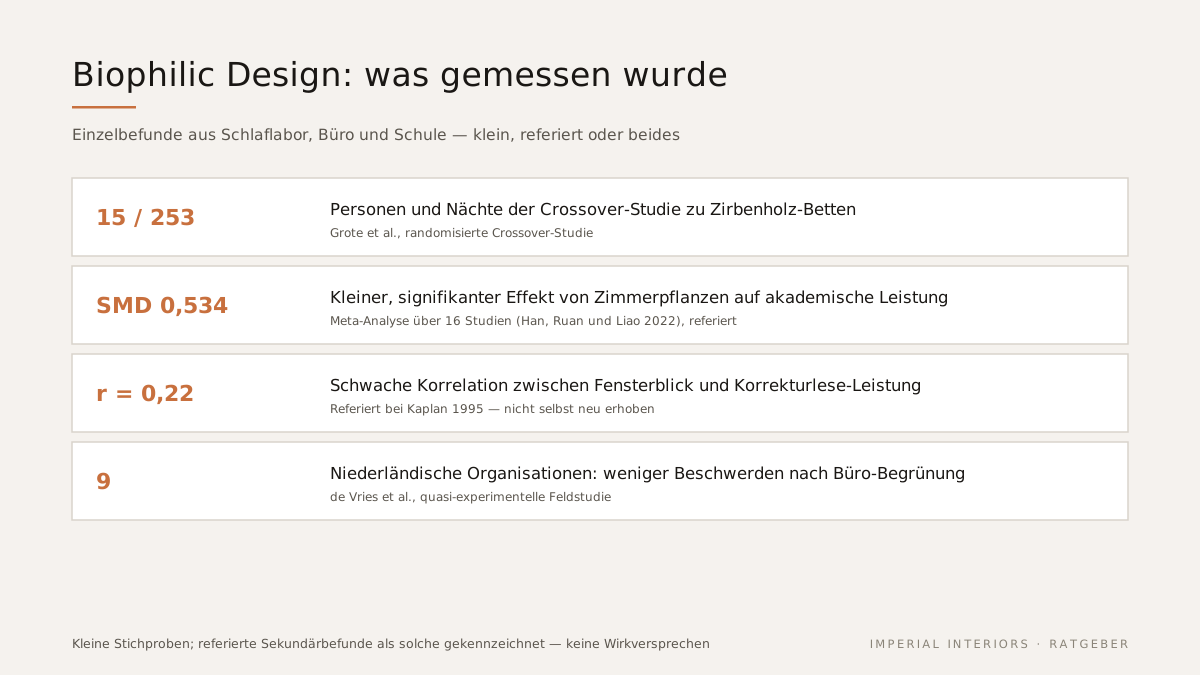
One of the field studies cited by Kaplan (Hartig et al. 1991) found that, after a 40-minute walk, a self-reported recovery score correlated only weakly with an objectively measured proofreading performance (r = 0.22) — a small statistical association that Kaplan cites in 1995 but did not measure himself.
On houseplants, a 2024 review article in Frontiers in Psychology summarises several studies. A review of 50 Chinese- and English-language studies (Han and Ruan 2019) reportedly concludes that houseplants most strongly influence self-reported perception — more positive and fewer negative feelings, less physical discomfort — while objective or physiological measurements are described separately and more weakly. The review also summarises that a meta-analysis pooling 16 studies (Han, Ruan and Liao 2022) reported a small but statistically significant effect of houseplants on academic performance (SMD 0.534); the original paper was not itself reviewed here. A quasi-experimental before-and-after field study across nine Dutch organisations, also cited there (de Vries et al.), found fewer complaints about dry air, as well as greater perceived privacy and workplace attractiveness, after office plants were introduced — though with considerable sample attrition, from an initial 594 down to 254 and finally only 128 participants across the measurement points. This study took place in an office context, not in the home. Important for context: these four individual findings were not checked against the respective original papers themselves, but taken, as described here, from the summarising 2024 review article.
Solid wood and wood scent: two small, exploratory studies
Closer to our own range is a randomised crossover study of 15 people over a total of 253 nights at a single Austrian study centre (Grote et al. 2021): it found higher vagal activity, a lower heart rate and more favourable cardiorespiratory coupling in beds made of solid stone-pine wood compared with melamine-coated chipboard beds — particularly in the first hours of sleep. The sample, at 15 people, is very small — that alone is not enough for a strong causal claim, even though the study was, according to its title, designed as randomised. A second, exploratory laboratory study in the context of Attention Restoration Theory and biophilic design (Shima, Maeda and Tsunetsugu 2025) examined wood scents rather than visible surfaces: the smell of hinoki wood was associated with a lower heart rate than no scent at all — a sign of faster recovery of the autonomic nervous system — while camphor scent showed no effect. The authors themselves explicitly describe their findings as «preliminary evidence», not as established proof.
What research on indoor spaces has not shown so far
A 2025 systematic review on green space and brain plasticity, produced at the University of Cambridge (Khalil 2025), explicitly states that, so far, no studies have directly examined greened architecture, or «biophilic interiors», for neural or psychological effects — even though exposure there is closer and longer than with outdoor green spaces. The review itself draws overall on only 23 individual studies on green space, predominantly on outdoor green spaces, with high methodological heterogeneity according to the author. For the specific indoor context, as it exists in a living room or bedroom, the state of research therefore remains patchy: the findings described here come predominantly from clinical, office or laboratory settings and from theoretical frameworks — not from a direct study of general home living. This does not mean that connections to nature in the home are ineffective, only that direct scientific testing of this is still lacking.
For your own home: context, not promises
No health promise for a specific piece of furniture — whether a bed or a light fitting — can be derived from the research described here. What can be said is this: genuine contact with nature, living plants and solid wood have been studied more often in the research to date than purely decorative elements, to which these findings do not automatically transfer. Anyone who wants to put these principles into practice at home will find beds and living-room furniture with different material approaches at our showroom on Nüschelerstrasse in Zurich, for instance from DUXIANA, NUVOSETTE, Flou and Natevo. However, no scientifically tested effect of individual products on sleep or well-being can be derived from this — the research on interior design in the home is, overall, still too thin for that. A personal conversation in the showroom is the best way to compare materials and finishes at your own pace.
Frequently asked questions
Is biophilic design scientifically proven?
Not in the sense of medical proof. According to Barbiero and Berto (2021), the term «biophilia» describes a theoretical concept from personality psychology going back to Erich Fromm and later E.O. Wilson. Individual elements — such as a window view of nature or houseplants — have been linked, in individual, mostly small studies, to statistical associations with well-being or performance. However, according to a systematic review from the University of Cambridge (Khalil 2025), there are as yet no direct studies of neural or psychological effects for spaces explicitly designed as «biophilic interiors».
What does Roger Ulrich's well-known window-view study show?
In 1984, Ulrich retrospectively reviewed hospital records of 23 gallbladder patients with a window view of a natural scene against 23 comparable patients with a view of a brick wall (hospital in Pennsylvania, period 1972–1981). The group with a nature view had shorter hospital stays, fewer negative nursing notes and a lower need for strong pain medication. The study is small and retrospective, and concerns a recovery situation in a hospital — not the private home directly.
Do houseplants demonstrably help with well-being?
A 2024 review article summarises that, according to a review of 50 studies (Han and Ruan 2019), houseplants chiefly influence self-reported perception — more positive and fewer negative feelings. The same review summarises that a meta-analysis of 16 studies reported a small but statistically significant effect on academic performance (SMD 0.534); the original paper was not itself reviewed here. A field study across nine Dutch offices found fewer complaints about dry air after plants were introduced, but lost most of the initially 594 participants by the second follow-up measurement. No robust, currently verifiable source exists for an air-purifying effect of houseplants.
What does the study on stone-pine beds show?
A randomised crossover study of 15 people over a total of 253 nights (Grote et al. 2021) found higher vagal activity, a lower heart rate and more favourable cardiorespiratory coupling in beds made of solid stone-pine wood compared with melamine-coated chipboard beds — particularly in the first hours of sleep. The sample, at 15 people, is very small; that alone is not enough for an established claim of effect.
What is the difference between Attention Restoration Theory and the stress-reduction approach?
According to Kaplan (1995), both are distinct, at times competing theories within environmental psychology that should not be treated as synonymous. The stress-reduction approach goes back to Roger Ulrich, whereas Kaplan's own «Attention Restoration Theory» (ART) describes recovery from the fatigue of directed attention via four components: Being Away, Extent, Fascination and Compatibility. Both theories are frameworks, not settled proof.
Sources & studies
The factual statements in this article are based on the following sources — each framed in the text as a study, testing institute, official figure, convention or manufacturer information:
- Ulrich, R.S. (1984): View through a window may influence recovery from surgery. Science 224(4647), 420–421
- Kaplan, S. (1995): The restorative benefits of nature: Toward an integrative framework. Journal of Environmental Psychology 15(3), 169–182
- Han, K.-T. (2024): Editorial: Effects of indoor plants on well-being. Frontiers in Psychology 15:1483441
- Grote, V. et al. (2021): Cardiorespiratory Interaction and Autonomic Sleep Quality Improve during Sleep in Beds Made from Pinus cembra (Stone Pine) Solid Wood. Int J Environ Res Public Health 18(18), 9749
- Shima, T., Maeda, K., Tsunetsugu, Y. (2025): Wood Odor Mapping on Arousal Axes: Exploring Correspondence with Physiological Indices of Stress Recovery. Int J Environ Res Public Health 22(11), 1716
- Barbiero, G., Berto, R. (2021): Biophilia as Evolutionary Adaptation: An Onto- and Phylogenetic Framework for Biophilic Design. Frontiers in Psychology 12:700709
- Khalil, M.H. (2025): Green Environments for Sustainable Brains: Parameters Shaping Adaptive Neuroplasticity and Lifespan Neurosustainability. Int J Environ Res Public Health 22(5), 690
Prefer personal advice?
Initial consultation, first home visit and initial concept are free and non-binding. Try our beds any time in the showroom at Nüschelerstrasse 30, Zurich.