
Pendant Light Over the Dining Table: Getting Height, Size and Number Right
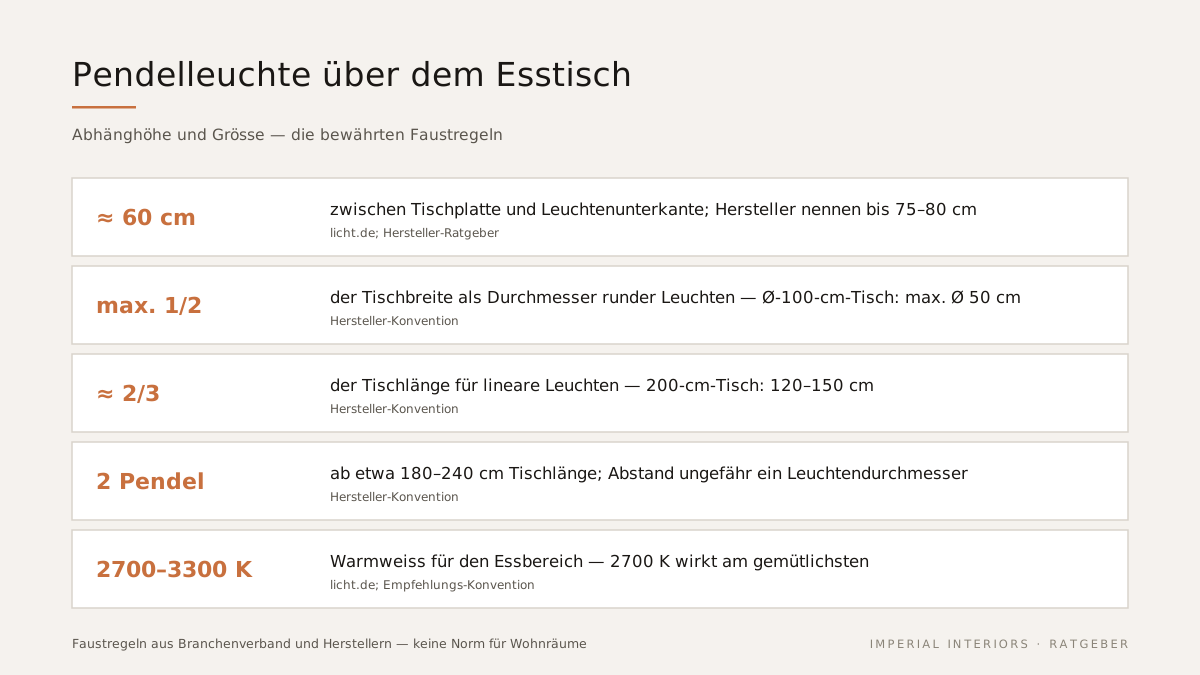
About 60 centimetres between the tabletop and the bottom edge of the fixture – that's the proven hanging height for a pendant light over the dining table; manufacturers cite up to 75 or 80 centimetres depending on the model. For size, two rules apply that are often confused: round fixtures measure at most half the table's width, linear fixtures around two-thirds of the table's length. From about 180 centimetres of table length, manufacturers recommend two pendants, and warm-white, dimmable light around 2700 Kelvin has become the established colour temperature. There's no standard for the private dining table – we show where each rule of thumb comes from.
The hanging height: about 60 centimetres above the tabletop
About 60 centimetres between the tabletop and the bottom edge of the fixture – that's the answer to the most common question in dining-table lighting. The industry body licht.de (Fördergemeinschaft Gutes Licht) puts it unambiguously: "60 centimetres above the table is right." The reasoning is practical: at this height, the light doesn't glare even with open shades, and the view of the person opposite stays clear. Hang the fixture lower and it sits in the middle of your sightline; hang it noticeably higher and an open shade can glare – licht.de explicitly advises against hanging it too high or too low. Fixture manufacturers set the frame a little wider: GANTlights recommends 60 to 75 centimetres for the bottom edge of the fixture, Lucide observes 60 to 80 centimetres as the usual hanging height – both manufacturer figures. In our consulting practice, we therefore start at 60 centimetres and adjust with people seated: only once everyone has taken their seats does it become clear whether the fixture glares or blocks sightlines.
Size: two rules of thumb that don't mean the same thing
Two rules circulate for fixture size – and they apply to different fixture types, which is why you shouldn't mix them up. Rule one concerns round and compact fixtures: according to manufacturer Lucide, their diameter should be at most half the table's width – the width, not the length of the table, is what counts. Rule two concerns elongated, linear fixtures: according to manufacturer GANTlights, they should take up around two-thirds of the table's length – here, the length is what counts. Swap the two rules and you'll quickly reach for the wrong size. In figures:
- Round table, Ø 100 cm: fixture at most Ø 50 cm (manufacturer figure, Lucide).
- Rectangular table, 100 × 180 cm: round fixture also at most Ø 50 cm – half the table's width, not half its length (Lucide).
- Linear fixture on a 160 cm table: 100–120 cm long (manufacturer figure, GANTlights).
- Linear fixture on a 200 cm table: 120–150 cm; on a 240 cm table: 140–180 cm (GANTlights).
Number: from around 180 centimetres of table length, it becomes two
A long table needs more than one pendant – from around 180 centimetres of table length, manufacturers recommend two fixtures, and three for very long tables. Lucide notes that a table of 100 × 200 centimetres is usually not sufficiently lit by a single lamp; GANTlights sees two pendants as the more relaxed solution for table lengths of 180 to 240 centimetres and advises three for very long tables. For the spacing between several pendants, Lucide gives a simple guideline: roughly one fixture diameter between each fixture. That way, the light spreads across the whole table instead of piling up in the middle – and the seats at the ends don't sit in half-darkness.
Light colour: warm white – ideally 2700 Kelvin, always dimmable
Warm-white light between 2700 and 3300 Kelvin is the established recommendation for the dining area – a convention from the industry body and the specialist trade, not a rule. The classification comes from licht.de: warm white (2700–3300 K) is perceived as cosy and comfortable, neutral white (3300–5300 K) creates a more businesslike mood, and daylight white above 5300 K feels cool and clinical. The specialist trade goes a step further: lighting adviser Prediger recommends warm-white or, better still, extra-warm-white light for the dining room with a colour rendering above CRI 90 – aimed directly at the table and dimmable; elsewhere, Prediger defines the light colour "extra warm white" as 2700 Kelvin. Dimmability pays off twice: licht.de describes how smart systems switch the fixture over the dining table from cooler task light to dimmed warm white – from homework light in the afternoon to dinner light in the evening. What lumens, Kelvin and CRI mean in detail, and what to look for when buying light bulbs, is explained in our guide "Buying Light Fixtures Without the Jargon".
The standard question: there is none for the private dining table
There's no binding standard for lighting private dining areas – every figure in this article is a convention from the lighting industry and manufacturer information, and we say so openly. The often-cited DIN EN 12464-1 in this context sets requirements for the lighting of indoor workplaces – offices, workshops, production spaces. It doesn't apply to the private dining room; if you read lux specifications for the home dining table somewhere, you're reading a transfer, not a rule. That doesn't diminish the rules of thumb: the fact that the industry body and several manufacturers independently arrive at around 60 centimetres of hanging height is a more reliable signal than any single figure from a single source. Knowing this origin lets you make an informed judgement rather than guess.
From guideline to the right fixture: advice in the showroom
Whether 60 or 75 centimetres is right in the end depends on how the fixture, table and room work together – and that's best judged from the original piece. In our showroom at Nüschelerstrasse 30 in Zurich, five minutes' walk from the main station, we advise on pendant lights for the dining table; our range includes lighting from Bomma. If you're not just looking for a single fixture but a lighting concept for the whole dining and living area, you can combine the visit with our interior design consultation – the initial consultation is free. Open Monday to Friday 10:00–19:00, Saturday 10:00–18:00.
Frequently asked questions
How high do you hang a pendant light over the dining table?
About 60 centimetres between the tabletop and the bottom edge of the fixture – this figure comes from the industry body licht.de. Fixture manufacturers set the frame a bit wider: GANTlights recommends 60 to 75 centimetres, Lucide observes 60 to 80 centimetres as the usual height. That way, the light doesn't glare even with open shades, and the view of the person opposite stays clear.
How big can the pendant light over the dining table be?
For round fixtures, according to manufacturer Lucide: diameter at most half the table's width – for a table 100 centimetres wide, that's a maximum of 50 centimetres. For linear fixtures, according to GANTlights: around two-thirds of the table's length, so 120 to 150 centimetres for a 200-centimetre table. The two rules apply to different fixture types and shouldn't be mixed up.
How many pendant lights does a long dining table need?
From around 180 centimetres of table length, manufacturers recommend two pendant lights, and three for very long tables (GANTlights); a 200-centimetre table, according to Lucide, is usually not sufficiently lit by a single lamp. Roughly one fixture diameter is the guideline for spacing between pendants.
Which light colour suits the dining table?
Warm white – licht.de defines the range as 2700 to 3300 Kelvin and describes it as cosy and comfortable. The specialist trade often recommends "extra warm white" for the dining room, around 2700 Kelvin, combined with high colour rendering (CRI above 90) and a dimmer. That's an established recommendation convention, not a standard.
Is there a standard for lighting the dining table?
No. DIN EN 12464-1 governs the lighting of indoor workplaces and doesn't apply to private living and dining areas. Hanging height, fixture size and light colour at the dining table rest on conventions from the lighting industry and on manufacturer information – reliable because several sources independently arrive at similar figures.
Sources & studies
The factual statements in this article are based on the following sources — each framed in the text as a study, testing institute, official figure, convention or manufacturer information:
- licht.de – Esszimmer (Wohnen)
- licht.de – Lichtrezepte für die Küche
- licht.de – Lichtfarbe
- licht.de – Normdetails DIN EN 12464-1
- Lucide – Ratgeber Pendelleuchte über dem Esstisch
- GANTlights – Ratgeber Pendelleuchte Esstisch
- Prediger Lichtberater – Licht im Esszimmer
- Prediger Lichtberater – Licht im Schlafzimmer
Prefer personal advice?
Initial consultation, first home visit and initial concept are free and non-binding. Try our beds any time in the showroom at Nüschelerstrasse 30, Zurich.