
Recognising Hand-Blown Crystal Glass: The Four Marks of Craftsmanship
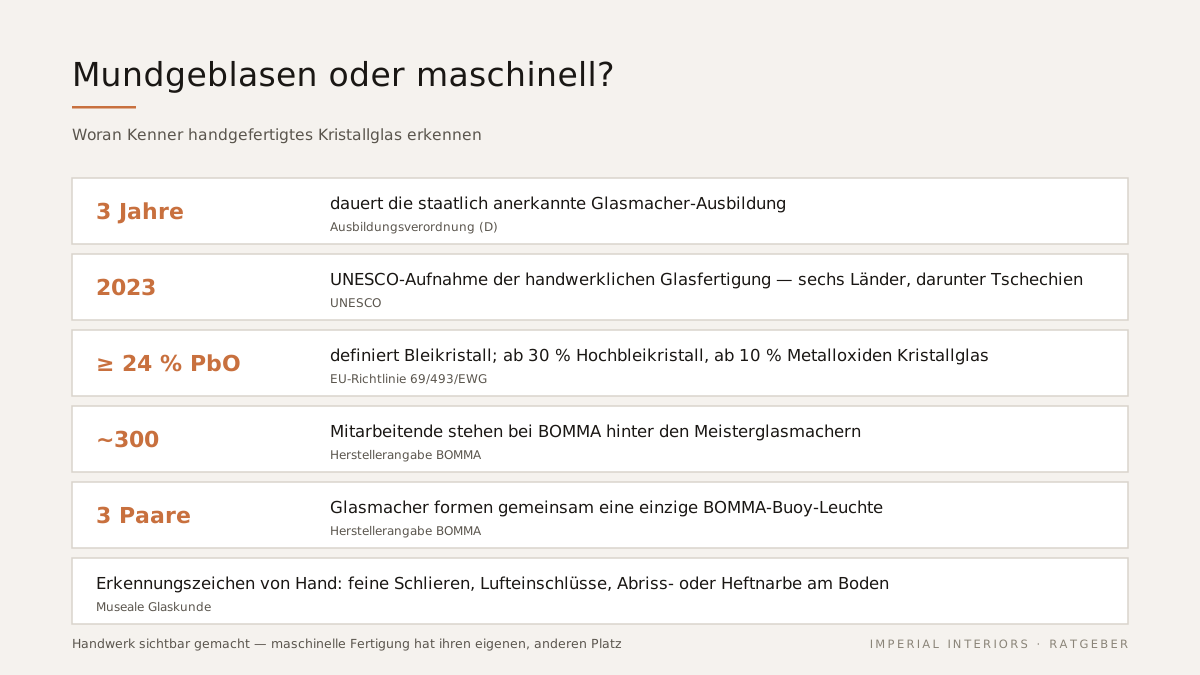
Hand-blown glass reveals itself through four marks: tiny air bubbles – glassmakers call them "seeds" – fine striations, slight variance in shape and size, and the pontil mark on the base where the punty iron was snapped off. In museum documentation, these features count as marks of manual production; one long-established glassworks calls them simply "proof of authenticity". On the term "crystal", EU directive 69/493/EEC helps: lead-free glass may also be called crystal glass if it contains at least 10 percent of certain metal oxides and meets density and refractive-index requirements. Knowing these features lets you judge instead of guess.
How do you recognise hand-blown glass? Four marks
You recognise hand-blown glass by marks that only handwork leaves behind – and that make every piece one of a kind. A long-established glassworks in Thuringia explicitly calls these features "proof of authenticity" of manufactory work: "Every glass is a one-off." That's the crucial shift in perspective when you look at it: what would count as a flaw in mass production is the signature of the craft here. Machine-made glass deliberately aims for uniformity – that's not a quality judgement, just the difference between series production and a one-off piece. If you hold a glass object in your hand or look at a light fixture against the light, watch for these four features:
- "Seeds": small round to slightly oval air bubbles in the glass – glassmakers' term for the typical air inclusions of handcrafted production.
- Striations and fine unevenness in the glass mass, most clearly visible against the light.
- Variance in shape, size and colour: no two pieces match exactly – hold two glasses from the same series side by side and it becomes visible.
- Pontil mark and punty scar: the pontil mark on the base is the spot where the punty iron was snapped off after production; on stemware, the punty scar sits on the foot. In museum documentation, both count as marks of manufacture pointing to handwork.
Is lead-free glass genuine crystal glass? What the EU directive says
Yes – lead-free glass may be sold as crystal glass if it meets the requirements of the European crystal-glass directive 69/493/EEC. The directive defines three categories in Annex I: full lead crystal contains at least 30 percent lead oxide (PbO), lead crystal at least 24 percent. The third category – crystal glass – needs no lead at all: it requires at least 10 percent of the metal oxides zinc oxide, barium oxide, lead oxide and/or potassium oxide, individually or combined, together with a density of at least 2.45 and a refractive index of at least 1.520. The category names in various languages are common translations of the directive text; the percentage figures are what matter. For a buying decision, that means: "lead-free" and "crystal" aren't mutually exclusive – what counts is the composition, not the label. Asking a retailer which category a glass meets is the right question to ask.
What makes hand-blown glass valuable: training, teamwork, time
The value of hand-blown glass lies in the skill built into every piece – and that can be quantified concretely. In 2023, UNESCO added "the knowledge, techniques and craftsmanship of handmade glass production" to the Representative List of the Intangible Cultural Heritage of Humanity, a joint inscription by six countries, including Czechia and Germany. UNESCO describes the craft as marked by high craftsmanship and strong team values: traditional glassworks operate through a division of labour by specialisation, because each step builds on the previous steps of other glassmakers – the knowledge is passed on within families, through apprenticeships in glassworks, and through formal training. The German UNESCO Commission describes how demanding the technique is: the gather, the glowing gob of glass on the blowpipe, is shaped through rotation, lung pressure and tools perfected over centuries; around 500 craftspeople in Germany carry this knowledge. The path there is long: glassmaker is a state-recognised training occupation in Germany with three years of training – from melting the glass through free-form shaping and blowing to forming the stem and foot. Buying a hand-blown object means paying, first and foremost, for these hours and this skill, not the raw material.
The BOMMA example: craft and high-tech in Světlá nad Sázavou
What this craft looks like today is shown by BOMMA – one of the lighting brands in our range. The glassworks is based in Světlá nad Sázavou in Czechia; in the directory of CzechTrade, the Czech state export agency, all Bomma products are listed as handmade, hand-blown crystal-glass pieces from its own state-of-the-art production. By its own account, BOMMA makes all its crystal light fixtures by hand; behind the master glassmakers stand around 300 employees. The glassworks promotes its own lead-free crystal glass that melts at 1250 to 1280 degrees Celsius – showing that "lead-free" and "crystal glass" aren't contradictory, per the EU system above: the third category needs no lead oxide. And the teamwork UNESCO describes becomes concrete here: for the large-format Buoy collection, three pairs of glassmakers' hands, according to the manufacturer, shape each hand-blown glass body together. The glassworks doesn't see itself as pure nostalgia, either – by its own account, it combines 500 years of Czech glassmaking tradition with the technologies of the future, with handwork and modern production technique interlocking.
Hand-blown glass is best judged on the object itself
Seeds, striations and shape variance are more reliably recognised on the real piece than in product photos – air inclusions and striations only show themselves in the light and from changing angles. In our showroom at Nüschelerstrasse 30 in Zurich, five minutes' walk from the main station, we show crystal light fixtures from BOMMA; the features described here can be checked calmly on the object and compared between individual pieces. If you'd like to integrate a light fixture into a room concept: the initial consultation is free, and delivery and assembly are handled throughout Switzerland by our own team — items in stock usually within 48 hours, made-to-order items according to the manufacturer's schedule. Open Monday to Friday 10:00–19:00, Saturday 10:00–18:00 – no appointment needed.
Frequently asked questions
How do I tell if a glass is hand-blown?
By four marks: small round to slightly oval air inclusions (glassmakers call them "seeds"), fine striations and unevenness, slight variance in shape, size and colour, and the pontil mark – the spot on the base where the punty iron was snapped off after production. In museum documentation, these features count as marks of manufacture pointing to handwork. A long-established glassworks explicitly calls them "proof of authenticity", not a flaw.
Is lead-free crystal glass genuine crystal glass?
Yes. Alongside full lead crystal (at least 30 percent lead oxide) and lead crystal (at least 24 percent), the EU crystal-glass directive 69/493/EEC also defines the category crystal glass: at least 10 percent zinc oxide, barium oxide, lead oxide and/or potassium oxide – individually or combined – with a density from 2.45 and a refractive index from 1.520. Lead isn't required for that; lead-free glass may also carry the designation crystal glass if it meets these figures.
Why is hand-blown glass more expensive than machine-made glass?
Because every piece contains the working time of several specialists. UNESCO describes handcrafted glass production as team work with a division of labour, where each step builds on the steps of other glassmakers; glassmaker training in Germany is state-recognised and takes three years. For large formats, several glassmakers work on one piece at the same time – for the BOMMA Buoy collection, that's three pairs of hands, according to the manufacturer. Add to that the one-off character: no two pieces are identical.
Is Bohemian glass UNESCO World Heritage?
Not the glass itself, but the craft: in 2023, UNESCO added "the knowledge, techniques and craftsmanship of handmade glass production" to the Representative List of the Intangible Cultural Heritage of Humanity. It's a joint inscription by six countries – Czechia, Finland, France, Germany, Hungary and Spain. What's honoured, then, is the craft technique, not a particular product, region or brand.
Where is BOMMA crystal glass made?
In Světlá nad Sázavou in Czechia: that's where the BOMMA glassworks is based, whose products are listed in the directory of the state export agency CzechTrade as handmade, hand-blown crystal glass. The glassworks promotes its own lead-free crystal glass; according to the manufacturer, around 300 employees stand behind the master glassmakers. In Zurich, BOMMA light fixtures can be seen in the Imperial Interiors showroom at Nüschelerstrasse 30.
Sources & studies
The factual statements in this article are based on the following sources — each framed in the text as a study, testing institute, official figure, convention or manufacturer information:
- UNESCO — Immaterielles Kulturerbe: handwerkliche Glasfertigung (2023)
- Deutsche UNESCO-Kommission — Manuelle Fertigung von mundgeblasenem Hohl- und Flachglas
- GlasmAusbV — Verordnung über die Berufsausbildung zum Glasmacher/zur Glasmacherin
- Richtlinie 69/493/EWG (Kristallglas), Volltext
- museum-digital Themator — «Alles aus Glas» (Museumsdokumentation)
- Farbglashütte Lauscha — Warenkunde zu Manufakturglas
- BOMMA — About
- CzechTrade Exporter Directory — Bomma
- Bomma Glassworks — Bomma Cullet
- Bomma Glassworks — Startseite
- BOMMA — Kollektion Buoy
Prefer personal advice?
Initial consultation, first home visit and initial concept are free and non-binding. Try our beds any time in the showroom at Nüschelerstrasse 30, Zurich.