
Buying Lights Without the Jargon: Lumens, Kelvin, Ra and “Dimmable”
Watts no longer tell you anything about brightness – by law, lumens are what count: an old 60-watt incandescent bulb officially corresponds to 806 lumens, 100 watts correspond to 1521 lumens. Add three details that must appear on every package: the light colour in kelvin, the colour rendering index (at least Ra 80 is mandatory, Ra 90 is the connoisseur's choice) and the dimmability note. If you can read these four values, you buy light like a professional.
Lumens instead of watts: the most important shift
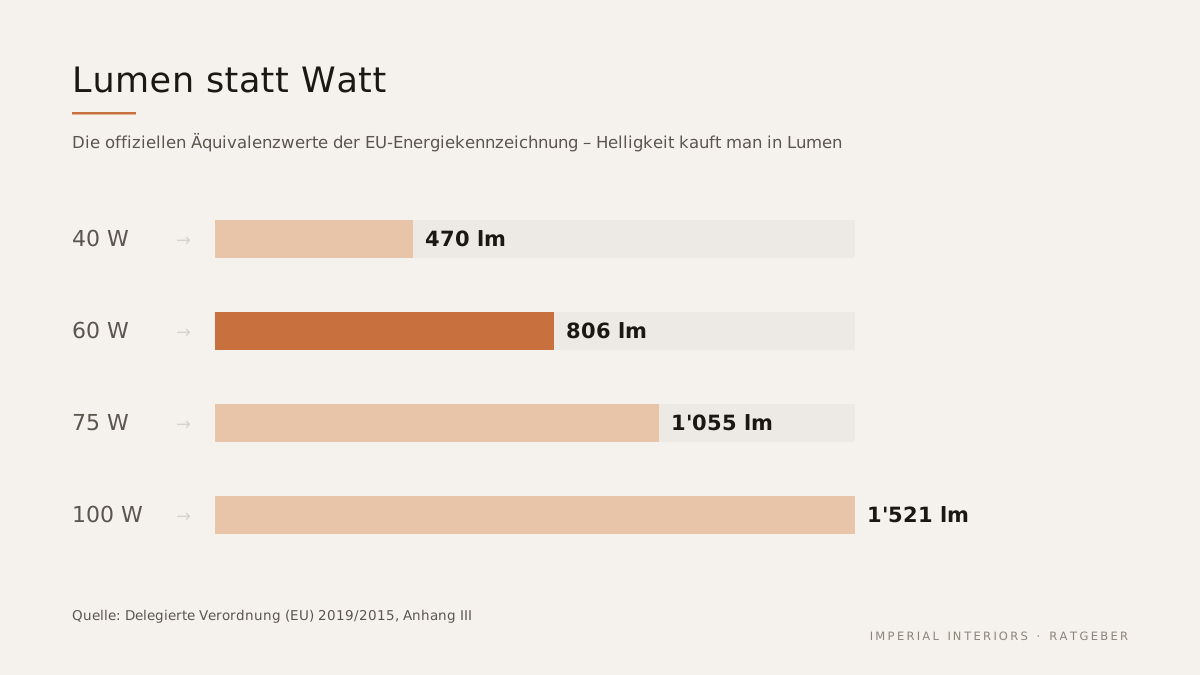
Watts measure power consumption, not brightness – with LEDs, the old watt reflexes are therefore worthless. The EU has regulated this consistently: on the packaging, the luminous flux in lumens must appear in type at least twice as large as the wattage. And so that nobody has to convert, the energy labelling regulation defines official equivalence values: 249 lumens correspond to the old 25-watt bulb, 470 lumens to the 40-watt, 806 lumens to the 60-watt, 1055 lumens to the 75-watt and 1521 lumens to the 100-watt incandescent bulb. These figures are the most reliable anchor when buying light bulbs. Since September 2021, the new energy label from A to G (without A+ and A++) has also applied – what it rates is efficiency in lumens per watt. Good to know: by design, decorative filament LEDs often end up in the lower classes, yet they are still many times more economical than the incandescent bulbs whose look they quote.
Kelvin: choosing the light colour
The second mandatory detail is the colour temperature in kelvin. The established classification – a lighting-standards convention – has three groups: warm white below 3300 K, neutral white from 3300 to 5300 K, daylight white above that. For living, dining and sleeping areas, warm white has proven itself – that is convention, not law, but it aligns with circadian research, which recommends warm, dimmed light in the evening. The most important practical mistake is quickly explained: different kelvin values in the same room zone. So when you buy replacement bulbs, note down the kelvin figure of the existing ones – it is stated on every package.
Ra: the underrated number for beautiful rooms
The colour rendering index (CRI, stated as Ra) measures, according to the definition of the International Commission on Illumination CIE, how faithfully a light source renders colours compared with a reference light source of the same colour temperature – as an average across eight standardised test colours. By law, LED light bulbs must achieve at least Ra 80. For rooms where materials are meant to work their effect – wood grain, fabrics, art, mouth-blown glass – Ra 90 and above has established itself as the quality threshold; that is market convention above the legal requirement, but the difference is visible at the dining table and in front of the wardrobe. In our lighting consultations we prefer to show the effect directly: the same fabric sample under Ra 80 and Ra 90+ is the most convincing argument.
Flicker and lifetime: what the fine print says
Two details that hardly anyone reads, but that reveal a lot about quality: first, flicker – the EU limits it measurably. Mains-operated LED light bulbs must comply with the short-term flicker metric PstLM of at most 1.0, and for the stroboscopic effect the tightened limit SVM ≤ 0.4 has applied since September 2024. Cheap products used to stand out unpleasantly here; today's limits have raised the level noticeably. Second, lifetime: it is defined as L70B50 – the point in time at which half of a population of light bulbs still delivers at least 70 percent of its initial luminous flux. So as a rule an LED does not “die” suddenly; it slowly grows dimmer over the years. 25,000 hours L70B50 therefore does not mean “25,000 hours, then darkness” – it describes a statistical brightness curve.
“Dimmable” does not always mean dimmable
Here too, the law helps: if a light bulb cannot be dimmed at all, or only with certain dimmers, this must be stated on the packaging, and the manufacturer must provide a list of compatible dimmers online. The rest is practical knowledge: old dimmers and LEDs often get along badly – if you experience flickering or humming, check the compatibility list first instead of swapping the bulb. The short checklist for buying:
- Choose brightness in lumens: ~470 lm replace 40 W, ~806 lm replace 60 W, ~1521 lm replace 100 W (official EU equivalences).
- Light colour: warm white (below 3300 K) for living areas; stay with one kelvin figure within a room zone.
- Colour rendering: at least Ra 90 for rooms where materials and colours count.
- Dimming: read the note on the packaging and check your dimmer against the manufacturer's compatibility list.
- Lifetime: compare the L70B50 value – and know that it describes a slow loss of brightness.
Frequently asked questions
How many lumens replace a 60-watt incandescent bulb?
806 lumens – that is the official equivalence value of the EU energy labelling (Regulation (EU) 2019/2015, Annex V, Table 7). Further anchors: 470 lm ≈ 40 W, 1055 lm ≈ 75 W, 1521 lm ≈ 100 W.
What does Ra 80 vs. Ra 90 mean – and when is more worth it?
Ra measures how faithfully colours are rendered (average across eight test colours, CIE definition). Ra 80 is a legal requirement for LEDs; Ra 90 and above is the market's quality threshold for rooms where wood, fabrics and art are meant to look right – the difference is visible to the naked eye.
What does “L70B50” mean for LED lifetime?
It is the normative lifetime definition: the point in time at which 50 percent of the light bulbs still deliver at least 70 percent of their initial luminous flux. So LEDs usually do not fail suddenly – they gradually grow dimmer.
Why do some LEDs flicker – and how do I recognise good ones?
Flicker is caused by the electronics in the light bulb. The EU limits it measurably: PstLM at most 1.0, stroboscopic effect SVM at most 0.4 (since September 2024). Current branded products must comply with these limits; when problems occur, dimmer compatibility is often the cause.
What do I need to watch for so that an LED is really dimmable?
Two things: the legally required dimmability note on the packaging and compatibility with your dimmer – manufacturers must provide a list of compatible dimmers online for this purpose. Old dimmers and LEDs are the most frequent source of trouble (flickering, humming).
Sources & studies
The factual statements in this article are based on the following sources — each framed in the text as a study, testing institute, official figure, convention or manufacturer information:
- Delegierte Verordnung (EU) 2019/2015 – Energieverbrauchskennzeichnung von Lichtquellen (Label A–G; Watt-Lumen-Äquivalenzen in Anhang V, Tabelle 7; L70B50-Definition).
- Verordnung (EU) 2019/2020 – Ökodesign-Anforderungen an Lichtquellen (Lumen-Pflichtangabe, Ra ≥ 80, Flimmern, Dimm-Kennzeichnung).
- Verordnung (EU) 2021/341 – Änderungsverordnung (SVM-Grenzwert 0,4 ab 1.9.2024).
- CIE – International Lighting Vocabulary: Definition «colour rendering index» (17-22-109); die acht Testfarben (R1–R8) sind in VO (EU) 2019/2020, Anhang I, definiert.
- licht.de: Hinweise zu DIN EN 12464-1 (Lichtfarben-Konvention).
Prefer personal advice?
Initial consultation, first home visit and initial concept are free and non-binding. Try our beds any time in the showroom at Nüschelerstrasse 30, Zurich.