
Does a Box Spring Bed Need a Topper?
No – a topper isn't a must: according to Stiftung Warentest (a German consumer-testing institute), good lying properties and comfortable sleep on a box spring bed are possible with or without a topper. A topper can soften a too-firm sleeping surface and add lying height; but it can also mean that the shoulder and hip zones of the mattress lose their effect, and it slows moisture wicking – ÖKO-TEST, another German testing institute, calls buying one "always just a compromise". We show what a topper can really do, where it gets in the way, and how DUXIANA solves the top layer as a replaceable component. Many people end up not needing one at all – and that's perfectly fine.
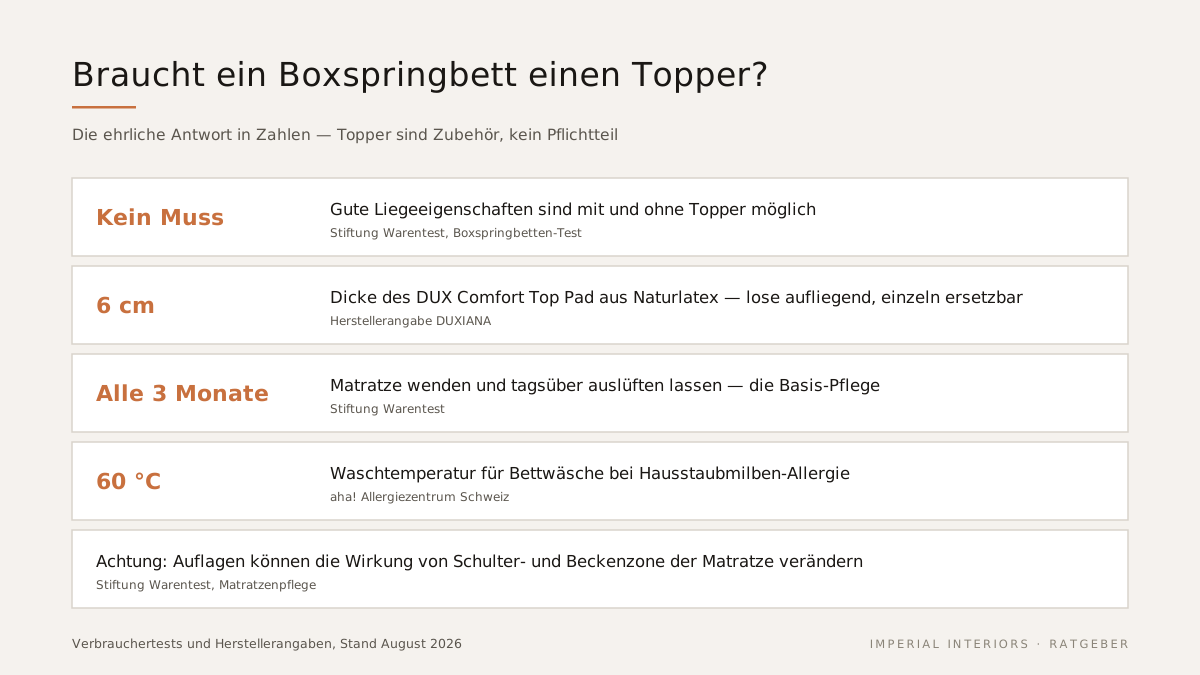
The short answer: no, a topper isn't a must
A box spring bed doesn't need a topper: "A mattress topper isn't a must," states Stiftung Warentest, a German consumer-testing institute – good lying properties and comfortable sleep are possible with or without one; the test compared box spring combinations in both versions. The fact that the question still comes up so often has to do with the market's packaging logic: complete box spring packages, according to Stiftung Warentest, typically consist of the sprung base, an innerspring mattress and often a topper as the top layer. So the topper is part of the usual scope of delivery – not part of the necessary construction. "Usually included" quickly becomes "absolutely essential" in a sales conversation, which is exactly where a sober look pays off. Honestly answered, the topper question is a question of comfort and situation: what matters is how you lie on the specific mattress – not whether a layer is missing.
What a topper can do: three honest reasons
A topper has three provable strengths – and shouldn't be credited with more. According to ÖKO-TEST, the most common reason for buying one is simply that the mattress feels too firm; add to that the extra lying height and the option to renew the bed's top layer separately. Cold foam, viscoelastic foam, gel and hybrid foam, and latex are common choices of material; ÖKO-TEST tested 13 foam models for ergonomics and microclimate. In detail:
- Softer feel: according to ÖKO-TEST, a topper's main purpose is to soften a too-firm sleeping surface – "usually the mattress is simply too firm".
- More lying height: according to ÖKO-TEST, the extra centimetres make getting in and out of bed easier for older or frail people.
- A replaceable top layer: a loosely laid topper can be replaced individually in case of accident or wear without swapping the mattress – DUXIANA makes this argument for its Top Pads, according to the manufacturer.
What a topper can't do: zone effect and microclimate
You shouldn't expect a topper to compensate for an unsuitable mattress – it's better documented that it can disrupt the mattress's tuning instead. Stiftung Warentest states that toppers change the lying properties of the mattress underneath: the shoulder and hip zones can lose their effect. If you've invested in a carefully zoned mattress and let it disappear under a thick topper, you may end up paying for ergonomics that no longer reach the surface. The second point is the microclimate: with a topper, moisture is wicked away less effectively, according to ÖKO-TEST – viscoelastic foams hinder moisture wicking especially strongly in the test, cold foams relatively little. Stiftung Warentest adds: if the mattress is surrounded by a protector and a topper, it can struggle to release absorbed moisture and, in the worst case, develop mould; toppers make sense mostly for people with incontinence, while for everyone else regular washing of the mattress cover is enough. ÖKO-TEST's conclusion sums it up: buying a topper is "always just a compromise". For an accessory that's often sold as though it were mandatory, those are remarkably clear statements from the testing institutes – and the reason we quote them here unabridged.
A different approach: the top layer as a replaceable component
The strongest argument for a separate top layer isn't "softer" but "renewable". DUXIANA places a Top Pad on its beds that, according to the manufacturer, lies loose on top and can be replaced individually in case of accident or wear – without having to replace the whole mattress. The DUX Comfort Top Pad, according to the manufacturer, has a core of natural latex wrapped in natural wool with a 100% cotton casing; it is deep-tufted and 6 cm thick. Understood this way, the topper isn't a softener but a plannable wear component: the costly mattress stays, and the top layer gets renewed. Regardless of the topper question, the basic care that Stiftung Warentest recommends applies to every mattress: turn it roughly every three months and let it air out uncovered during the day. And for house-dust-mite allergies, a topper is not the remedy of choice: the aha! Swiss Allergy Centre recommends mite-allergen-proof encasings for the mattress, pillow and duvet, plus regular washing of bed linen and pyjamas at 60 degrees.
How to find out for yourself
The topper question gets answered by trying the bed – not on a spec sheet. Whether a sleeping surface feels too firm, right, or too soft for you is something you can only sense in direct comparison: once with a topper, once without, in your usual sleeping position and with a few minutes of patience per variant. In our showroom at Nüschelerstrasse 30 in Zurich, five minutes' walk from the main station, you can do exactly that without an appointment – on our NUVOSETTE box spring beds (from CHF 3'900) as well as on DUX beds with a Top Pad (DUXIANA from CHF 5'300). Our consulting experience matches the testing institutes: if you choose the right mattress from the start, you often don't need a topper. And if you do want one, choose it as a deliberate comfort refinement – not because it happened to come in the package. We're open Monday to Friday from 10:00–19:00 and Saturday from 10:00–18:00.
Frequently asked questions
Does a box spring bed absolutely need a topper?
No. According to Stiftung Warentest, a mattress topper isn't a must: good lying properties and comfortable sleep are possible with or without one. That complete box spring packages often include a topper is standard scope of delivery, not a technical necessity. What matters is how you lie on the specific mattress.
What does a topper actually do on a box spring bed?
A topper softens a sleeping surface that feels too firm – according to ÖKO-TEST, its main purpose – and adds lying height, which makes getting in and out of bed easier for older or frail people. A loosely laid top layer can also be replaced individually if it wears out, without swapping the mattress. Honestly, a topper shouldn't be credited with more than that.
Can a topper compensate for an unsuitable mattress?
You shouldn't count on it. Stiftung Warentest states that toppers change the lying properties of the mattress – the shoulder and hip zones can lose their effect. A topper refines surface comfort, in other words, but can disrupt the tuning of a zoned mattress. If the mattress is fundamentally wrong for you, replacing it is the cleaner solution.
What should house-dust-mite allergy sufferers look for with their bed?
Not the topper, but encasings: for a house-dust-mite allergy, the aha! Swiss Allergy Centre recommends mite-allergen-proof covers for the mattress, pillow and duvet, plus regular washing of pillowcases, bed linen and pyjamas at 60 degrees. According to manufacturer information, the encasings themselves are usually washed once or twice a year.
How is the topper handled on DUX beds from DUXIANA?
As a replaceable component: according to the manufacturer, the DUX Comfort Top Pad has a natural-latex core wrapped in natural wool with a 100% cotton casing; it's deep-tufted and 6 cm thick. Because it lies loose on top, it can be replaced individually in case of accident or wear – without swapping the whole mattress.
Sources & studies
The factual statements in this article are based on the following sources — each framed in the text as a study, testing institute, official figure, convention or manufacturer information:
Note: This article provides general knowledge and does not replace medical advice. Persistent complaints should be clarified by a doctor.
Prefer personal advice?
Initial consultation, first home visit and initial concept are free and non-binding. Try our beds any time in the showroom at Nüschelerstrasse 30, Zurich.