
Interior Styles at a Glance: From Bauhaus to Japandi
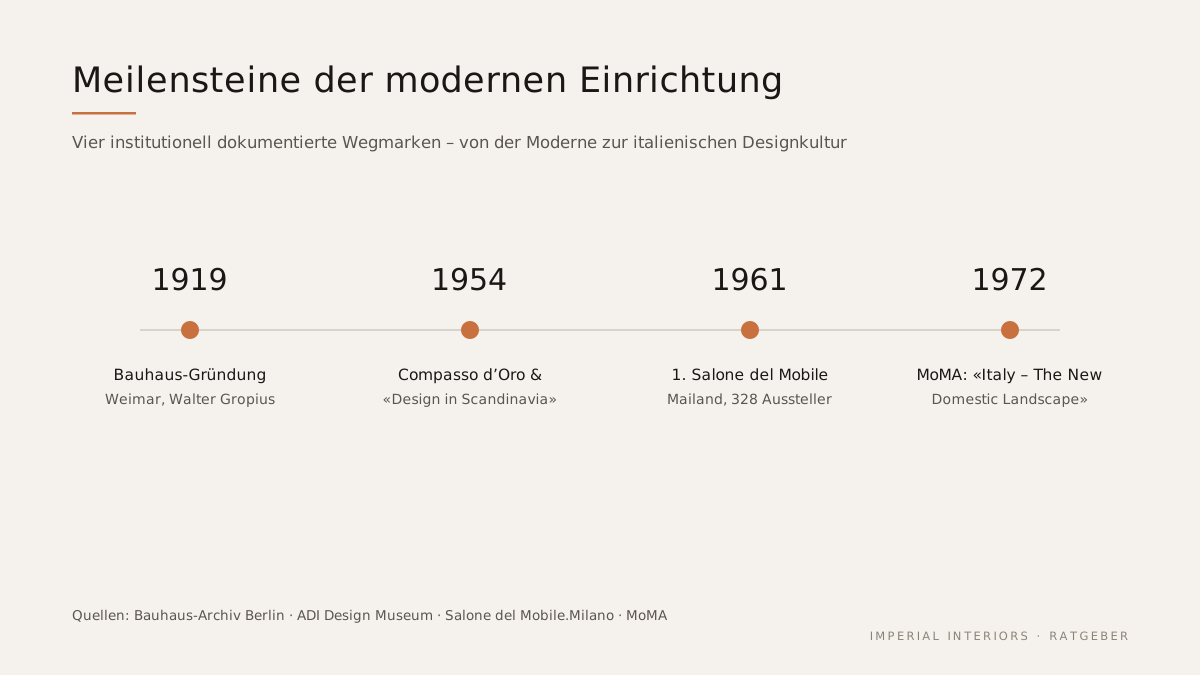
Styles are maps, not laws: the Bauhaus (1919–1933) laid the foundation of modernism, “Mid-Century Modern” was only defined as a design movement in 1984 by a book, Scandinavian design conquered the world from 1954 with a traveling exhibition, and Italian modernism institutionalized itself with the Compasso d'Oro (1954) and the first Salone del Mobile (1961). Japandi, in turn, is a young label – with, however, a very real historical root.
Bauhaus and modernism: the foundation
On April 12, 1919, Walter Gropius founded the Staatliches Bauhaus in Weimar; in 1925 the school moved to Dessau, and in 1933 it was closed under pressure from the National Socialists. Its program – the unity of art, craft and, from 1923, industry (“Art and technology – a new unity”) – shapes interiors to this day: clear forms, honest materials, function before ornament. Anyone buying a pared-back tubular-steel or glass piece today is buying an idea from 1919.
Mid-century and Scandinavia: postwar modernism
“Mid-Century Modern” sounds like an era, but it is a retrospective label: the term was already circulating in the mid-1950s, but it was Cara Greenberg's 1984 book that defined and popularised it as a design movement; by convention it refers to the furniture of roughly 1945 to 1970 – organic forms, warm woods, new materials. In parallel, the traveling exhibition “Design in Scandinavia”, which toured North America from 1954, shaped the international image of Scandinavian design: simple, functional, nature-oriented everyday design. Today, both currents are less a style than a basic vocabulary – their designs work in almost any setting.
Italian modernism: design as an institution
No country has institutionalized design as consistently as Italy: in 1954 the Compasso d'Oro was established – after an idea by Gio Ponti and Alberto Rosselli, today under the auspices of the ADI Design Museum in Milan. In 1961 the first Salone del Mobile followed in Milan, with 328 exhibitors and around 12,000 visitors, founded to promote the export of Italian furniture – today the world's leading furniture fair. And in 1972, New York's MoMA definitively canonized Italian design as world-class with the exhibition “Italy: The New Domestic Landscape”. This tradition – craft, industry and art in one – is the reason our range is so Italian in character: Flou and the Milanese lighting culture stand precisely in this line.
Japandi and industrial: young labels, real roots
Two popular styles deserve honest framing. “Japandi” is a young marketing label without art-historical canonization – yet the connection behind it is documented by museums: Designmuseum Danmark records the Japanese influence (Japonisme) on Danish craft from around 1870 and calls it a catalyst of Danish modernism. Reduction meets coziness – the idea, then, is one hundred and fifty years old; only the word is new. “Industrial”, in turn, is rooted in the loft conversions by New York artists in SoHo in the 1960s and 70s, described sociologically in Sharon Zukin's standard work “Loft Living” (1982): exposed brick, steel and open floor plans turned from necessity into aesthetic.
And which style suits you?
Style categories are conventions of the market, not science – and mixing styles is historically the norm, not the exception. In our consultations we therefore do not ask “Which style?” but rather: how do you live, which materials touch you, what should the room be able to do? From this emerges a personal concept that, where classics are concerned, follows one criterion: authorized editions and clear provenance instead of copies.
Frequently asked questions
What distinguishes Bauhaus from Mid-Century Modern?
The Bauhaus (1919–1933) was a real school with a program – the unity of art, craft and industry. “Mid-Century Modern” is a retrospective label for the furniture of roughly 1945–1970, defined as a design movement only in 1984 by Cara Greenberg. One is the foundation, the other the postwar flowering.
Is Japandi more than a trend?
The word is young and not canonized in art history – but the connection behind it is real: the Japanese influence on Danish design has been documented by museums since around 1870 (Designmuseum Danmark) and is considered a catalyst of Danish modernism.
Can you mix interior styles?
Absolutely – mixing styles is historically the norm. Styles are ordering conventions of the market, not rules. What matters is a common denominator of material, color and proportion – which is exactly what consultation is for.
How do you recognize Italian design classics?
By institutional anchors: Compasso d'Oro awards (since 1954), presence at the Salone del Mobile (since 1961) and museum canonization (MoMA 1972, for instance) – and, when buying, by authorized editions with clear provenance.
Sources & studies
The factual statements in this article are based on the following sources — each framed in the text as a study, testing institute, official figure, convention or manufacturer information:
- Bauhaus-Archiv / Museum für Gestaltung: 14 Years of Bauhaus – A Chronology.
- Begriffsgeschichte «Mid-Century Modern» (Cara Greenberg 1984) – dokumentiert mit Belegen.
- Designmuseum Danmark: Learning from Japan (Japonismus als Katalysator der dänischen Moderne).
- Sharon Zukin (1982): Loft Living – Culture and Capital in Urban Change.
- ADI Design Museum: The ADI Compasso d'Oro Award (seit 1954).
- Salone del Mobile.Milano: 60 years of the Salone del Mobile (erster Salone 1961).
- MoMA: Italy – The New Domestic Landscape (1972).
Prefer personal advice?
Initial consultation, first home visit and initial concept are free and non-binding. Try our beds any time in the showroom at Nüschelerstrasse 30, Zurich.