
Color in the Home: What Really Works – and What Is a Myth
Light ceilings and walls make rooms appear measurably taller – floor color plays no role in this. That is experimentally proven. Not proven, by contrast, is much of what is said about color psychology: the definitive research review classifies the field as young and inconsistent, and blanket claims such as “blue calms” have no scientific backing. Color remains above all one thing: a question of light, material and taste.
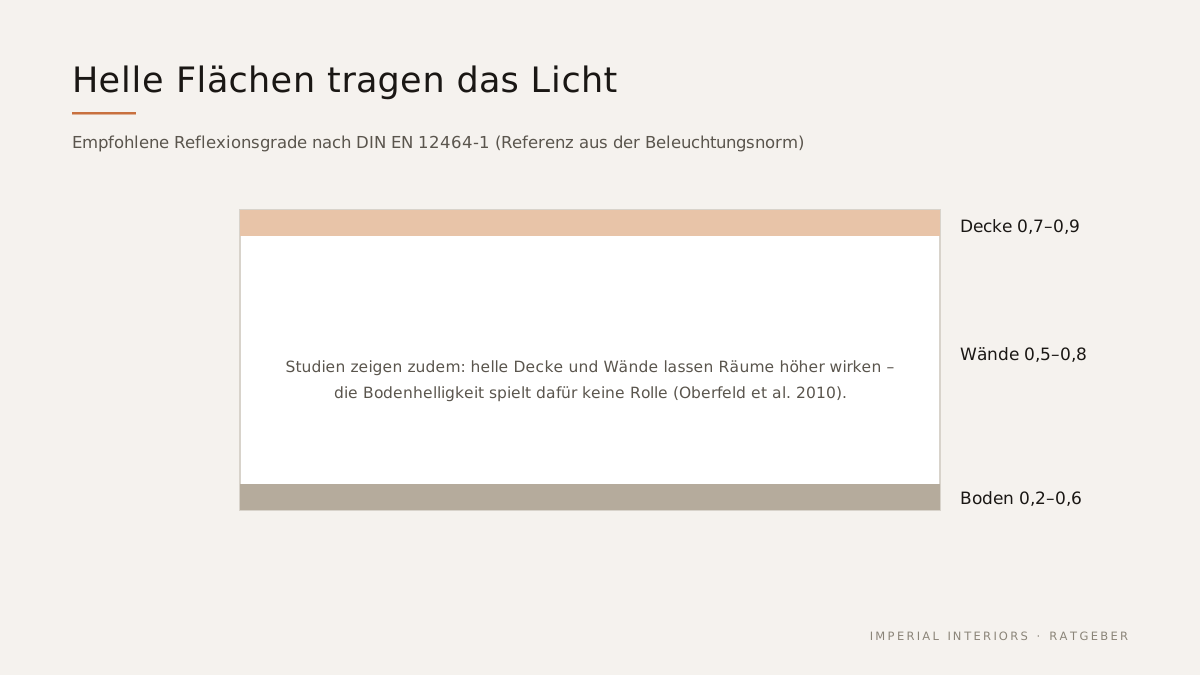
What colors demonstrably do: light and proportion
Physically, reflection is undisputed: light surfaces return more light to the room. As a reference, the lighting standard EN 12464-1 recommends reflectance values of 0.7 to 0.9 for ceilings, 0.5 to 0.8 for walls and 0.2 to 0.6 for floors. Added to this is a cleanly documented perceptual effect: in psychophysical experiments, lighter ceilings and lighter walls made rooms appear taller – the effects add up, while the lightness of the floor played no role in perceived room height. A dark floor beneath light walls is therefore not only elegant but entirely safe from a perceptual-psychology standpoint.
The size effect is overestimated
How much “larger” can color make a room? The sober answer from a study on perceived spaciousness: floor area dominates (correlation r = 0.60), followed by the effect of the room's boundaries – with the amount of light controlled, the color effect is small (r = 0.14). In practical terms: if you want a room to feel more generous, you gain far more with more light and more free floor area than with any color trick.
Color psychology: the honest balance sheet
“Blue calms, red activates, green aids concentration” – sentences like these sound like science, but they are not. The definitive review by Elliot and Maier in the Annual Review of Psychology classifies color psychology as a research field “at an early stage of development”: effects are context-dependent, culturally variable and often poorly replicated; considerable further research, it concludes, is needed before application recommendations can be made. The popular claim that blue bedrooms lengthen sleep likewise goes back to retailer surveys, not controlled studies. Our consulting stance is therefore clear: choose colors by light, material, architecture and personal preference – without psychological promises.
Practical guardrails
- Low rooms: keep the ceiling and walls light – the best-documented “height” lever; the floor may be dark.
- Light first, then color: always sample shades in the room's real light (day and evening).
- Think in material colors: wood, fabrics and leather are color carriers of the first order.
- The 60-30-10 proportion rule (base tone, secondary tone, accent) is a pure rule of thumb with no scientific origin – useful as a starting aid, not as a law.
- For the bedroom, lighting design (warm, dimmable) has proven effect – wall color is a matter of taste.
Frequently asked questions
Do light wall colors really make rooms larger?
Taller: yes – lighter ceilings and walls demonstrably increase perceived room height (floor color is irrelevant here). More spacious: only to a limited extent – perceived size is dominated by floor area; the color effect is small.
Is it true that blue calms?
There is no scientific backing for this. The definitive review (Elliot & Maier 2014) describes color psychology as a young field with context-dependent, poorly replicated effects. Choose colors by light, material and preference – not by psychological promises.
What is the 60-30-10 rule?
A design rule of thumb for color proportions: around 60% base color, 30% secondary color, 10% accent. It has no scientific origin, but it helps as a simple starting point to keep a color scheme calm.
Sources & studies
The factual statements in this article are based on the following sources — each framed in the text as a study, testing institute, official figure, convention or manufacturer information:
- Oberfeld D, Hecht H, Gamer M (2010): Surface lightness influences perceived room height. Quarterly Journal of Experimental Psychology 63(10).
- Stamps AE (2011): Effects of Area, Height, Elongation, and Color on Perceived Spaciousness. Environment and Behavior 43(2).
- Elliot AJ, Maier MA (2014): Color Psychology – Effects of Perceiving Color on Psychological Functioning in Humans. Annual Review of Psychology 65:95–120.
- licht.de: Hinweise zu DIN EN 12464-1:2021 – Reflexionsgrade im Raum.
Prefer personal advice?
Initial consultation, first home visit and initial concept are free and non-binding. Try our beds any time in the showroom at Nüschelerstrasse 30, Zurich.