
Lighting Design for Living Spaces: Lux, Kelvin and the Three Layers
There is no binding lighting standard for residential spaces – practice takes its cues from the workplace standard EN 12464-1: around 100 lux for circulation areas, 500 lux for reading and work areas. Two principles come on top: warm, dimmed light in the evening (circadian research supplies the rationale) and a structure in three layers – ambient, task and accent lighting.
What standards can offer – and what they can't
First, an honest framing: no lighting standard exists for private residential spaces. The European standard EN 12464-1 governs the lighting of workplaces – yet its values serve residential lighting design as a proven reference, and the Swiss standard SIA 500 refers to its minimum values for residential buildings. From this, reliable guide values can be derived: around 100 lux for hallways and circulation areas, 200 lux for stairs and cloakrooms, 500 lux for reading, work and kitchen work areas. Once you know this spread, you understand the most important principle of lighting design: it is not the room that needs a brightness level – it is the activity.
Understanding Kelvin: light color
Color temperature is stated in Kelvin and divided normatively into three groups: warm white below 3300 K, neutral white between 3300 and 5300 K, daylight white above. Which light color “belongs” in which room, by contrast, is convention and taste – there are no scientifically fixed feel-good values per room. What has proven itself in practice: warm white for living and sleeping areas, more neutral light where concentrated work takes place – and staying with one light color within a given zone, because mixtures feel restless.
In the evening: warm and dimmed – that much is proven
On one point, the research is clear: light is the primary zeitgeber of the internal clock, and bright, short-wavelength (blue) light in the evening disrupts sleep. In its position statement, the International Commission on Illumination CIE explicitly recommends keeping the biologically effective (melanopic) light dose low in the evening. A randomized study in PNAS demonstrated the mechanism drastically: evening reading on a light-emitting display suppressed melatonin release by around 55 percent and shifted the internal clock by more than an hour and a half – compared with a printed book. The study concerned displays, not room lighting, and was small (12 participants); it nevertheless clearly supports the direction of the recommendation: warm light colors and reduced brightness in the evening, especially in the bedroom.
The three lighting layers
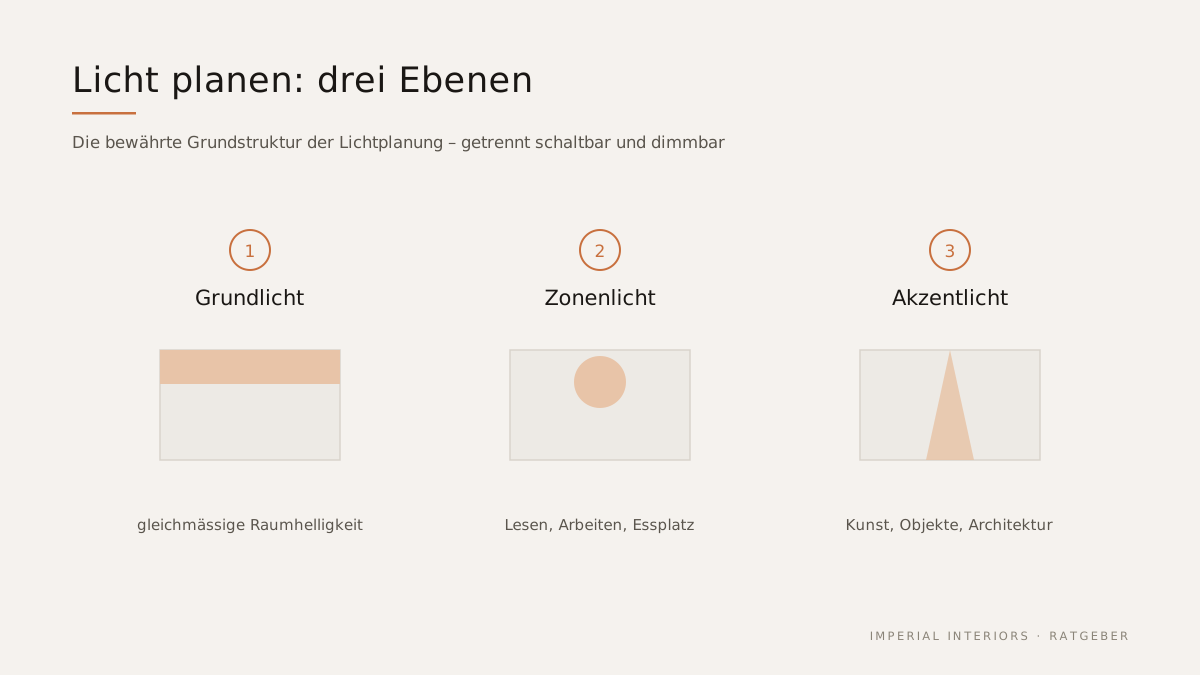
The working tool of lighting design is the three-layer concept – an established practical convention that goes back to the lighting categories of the American lighting designer Richard Kelly from the 1950s: ambient lighting provides even orientation throughout the room, task lighting brings the necessary lux to reading, dining and work areas, accent lighting stages objects, art and architecture. What matters most is that the layers can be switched and dimmed separately – only that turns a ceiling light into a lighting mood.
- Ambient lighting: even and glare-free – ceiling or indirect lighting.
- Task lighting: targeted where activities take place (guide value 300–500 lux at work and reading areas).
- Accent lighting: floor, table and picture lights give the room depth.
- Plan everything dimmable – the amount of light should be able to follow the course of the day.
- Fix the lighting design before electrical work: outlets follow the furnishing plan.
Frequently asked questions
Is there a standard for residential lighting?
No. EN 12464-1 applies to workplaces; for residential spaces its values serve as a reference (among other things via the reference in SIA 500): around 100 lux for circulation areas, 200 lux for stairs, 500 lux for reading and work areas.
Which light color for which room?
Only the scale is normatively defined: warm white below 3300 K, neutral white 3300–5300 K, daylight white above. Assigning colors to rooms is convention – warm white has proven itself for living and sleeping, more neutral light for working. In the evening, circadian research clearly argues for warm and dimmed.
Does bright light in the evening really disrupt sleep?
Yes, the direction is well documented: light is the primary zeitgeber of the internal clock, and the CIE recommends keeping the biologically effective light dose low in the evening. In a PNAS study, evening display light suppressed melatonin release by around 55 percent.
Sources & studies
The factual statements in this article are based on the following sources — each framed in the text as a study, testing institute, official figure, convention or manufacturer information:
- licht.de: Hinweise zu DIN EN 12464-1:2021 – Lichtqualität im Raum (Norm-Referenz).
- Schweizer Fachstelle Hindernisfreie Architektur: Beleuchtung in Wohnbauten (SIA 500 / SN EN 12464-1).
- Chang AM et al. (2015): Evening use of light-emitting eReaders negatively affects sleep, circadian timing, and next-morning alertness. PNAS 112(4):1232–1237.
- CIE (2019): Position Statement on Non-Visual Effects of Light – Recommending Proper Light at the Proper Time, 2. Aufl.
Prefer personal advice?
Initial consultation, first home visit and initial concept are free and non-binding. Try our beds any time in the showroom at Nüschelerstrasse 30, Zurich.