
Furnishing Small Rooms: What Really Creates Space
46.6 m² of living space per person – that is how Switzerland lives on average; in large city centers it is closer to 41 m². Furnishing compactly is everyday reality here. Perception research supplies clear levers: visible floor area dominates the impression of size, and light ceilings and walls make rooms appear taller. Plus one honest caveat: “less furniture automatically feels larger” is not proven in such blanket terms.
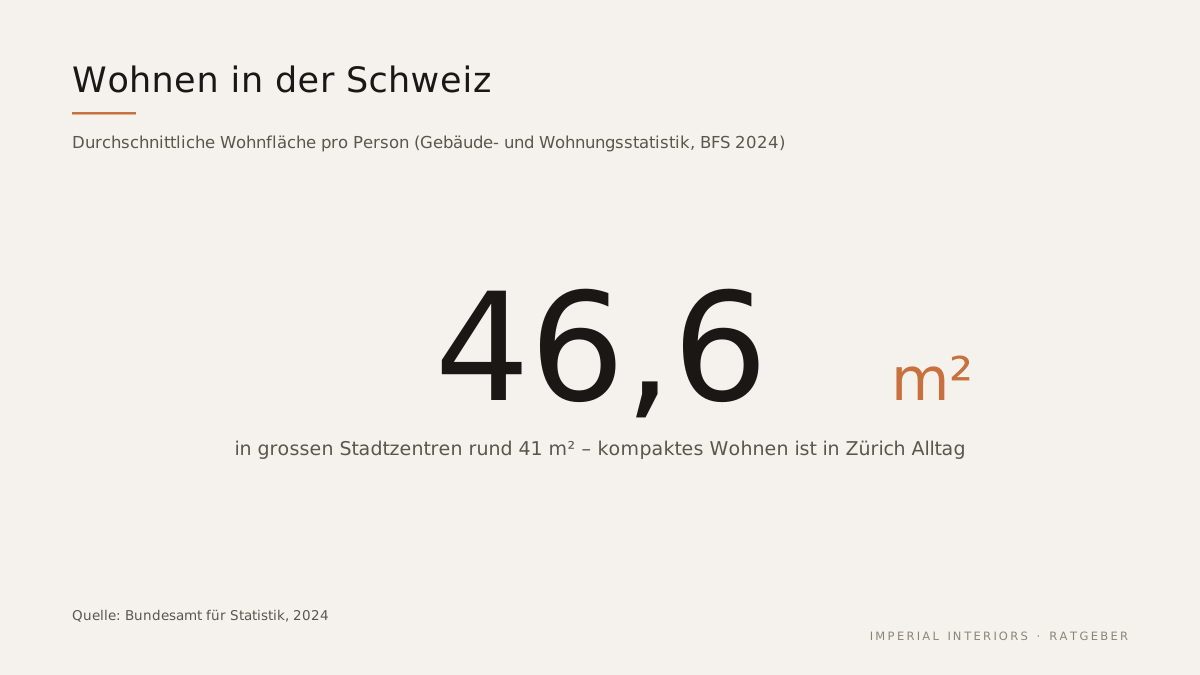
Compact living is the Swiss norm
The buildings and dwellings statistics of the Swiss Federal Statistical Office put the average living space per person in 2024 at 46.6 square meters – stagnant for several years now – and at around 41 square meters in large city centers. If you are furnishing a home in Zurich, you are almost always planning with limited space. That is not a shortcoming but a design task: compact rooms forgive less chance and reward planning all the more.
The two proven levers: floor area and light
Research on perceived spaciousness shows: visible floor area is by far the strongest factor, color has only a weak effect – and a good amount of light is considered another important lever. For furnishing, this means: free up floor area (leg-forward or wall-mounted furniture lets the floor run through), do not block daylight, and increase the amount of light with several sources. For low rooms, the second proven effect comes into play: a light ceiling and light walls increase perceived room height – and the floor can happily stay dark.
Honestly: two classics rest on thinner evidence than you might think
First, the minimalism reflex: the research on degree of furnishing is inconsistent – in experiments, a furnished room sometimes appeared taller yet less spacious, and in virtual reality, furnishing showed no significant effect on perceived size. “Clear it out and it will feel large” is therefore not an established truth; what matters more is how much floor remains visible. Second, the mirror: that mirrors visually enlarge rooms is a plausible convention – a flat mirror doubles the visual depth – but controlled residential studies are lacking. We still gladly recommend mirrors opposite windows: as a time-tested design device, not as a proven effect.
In practice: few pieces, the right ones
From our consulting practice – flagged as experience-based knowledge:
- A few large pieces instead of many small ones: one properly proportioned sofa calms a room more than three small furnishings.
- Plan for multifunction: sofa beds with genuine sprung-core sleeping comfort (from Flou, for example), beds with storage, extending tables.
- Use the height: floor-to-ceiling, made-to-measure wall units swallow storage without eating floor space.
- Keep circulation routes clear – the dimensions of barrier-free building serve as a comfort reference (passages from 80 cm).
- Light in three layers even in a small room: there especially, good light stands in for missing square meters.
Frequently asked questions
How much living space per person do people have in Switzerland?
On average 46.6 m² (FSO, buildings and dwellings statistics 2024), in large city centers around 41 m². The average dwelling measures 102 m².
Do mirrors really make small rooms larger?
Visually plausible, but not backed by residential studies: a flat mirror doubles the visible depth of view. Usable as a time-tested design device – opposite a window, for instance – just without the science label.
Does it help to place as little furniture as possible?
Not proven in such blanket terms – the research on degree of furnishing is contradictory. What is proven: visible floor area dominates the impression of size. A few well-proportioned pieces with visible floor beneath them deliver both.
Sources & studies
The factual statements in this article are based on the following sources — each framed in the text as a study, testing institute, official figure, convention or manufacturer information:
- Bundesamt für Statistik: Gebäude- und Wohnungsstatistik 2024 – Flächenverbrauch/Wohnverhältnisse (46,6 m² pro Person).
- Stamps AE (2011): Effects of Area, Height, Elongation, and Color on Perceived Spaciousness. Environment and Behavior 43(2).
- Oberfeld D, Hecht H, Gamer M (2010): Surface lightness influences perceived room height. QJEP 63(10).
- von Castell C, Oberfeld D, Hecht H (2014): The Effect of Furnishing on Perceived Spatial Dimensions and Spaciousness of Interior Space. PLOS ONE 9(11):e113267.
- Schweizer Fachstelle Hindernisfreie Architektur: Türen und Durchgänge in Wohnbauten (SIA 500:2009).
Prefer personal advice?
Initial consultation, first home visit and initial concept are free and non-binding. Try our beds any time in the showroom at Nüschelerstrasse 30, Zurich.