
Which Bed for Back Pain? What Studies Really Show
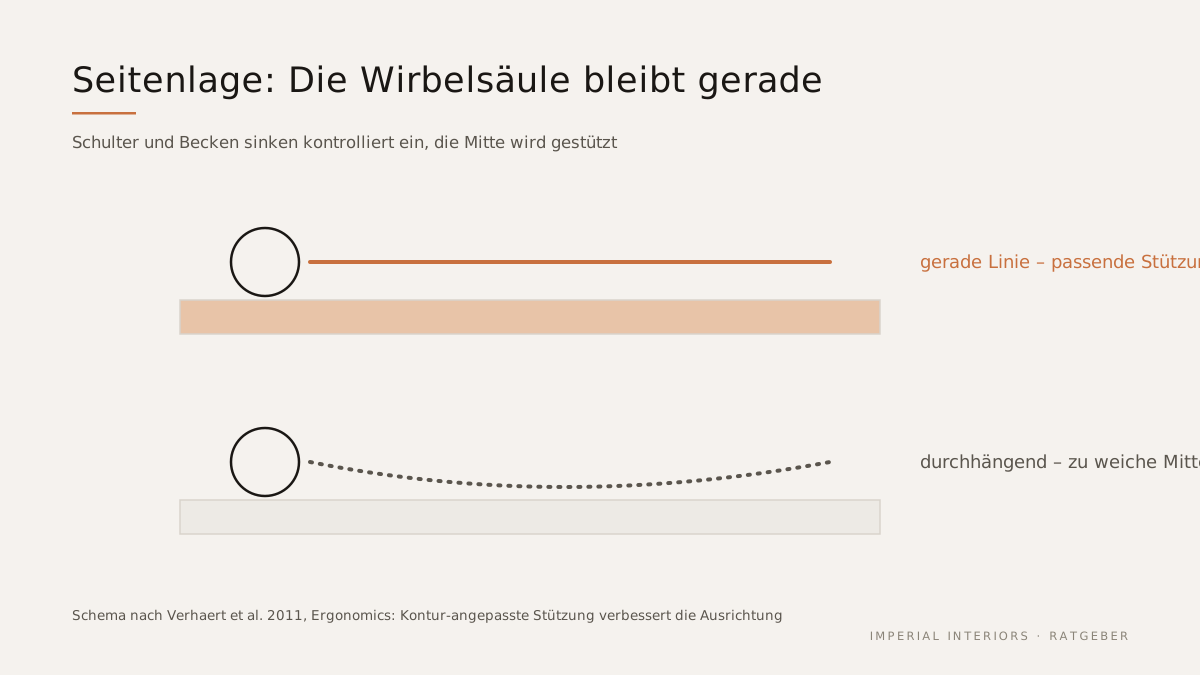
The best available evidence supports a medium-firm, individually fitted bed for back pain – not the hardest one possible. In a randomised Lancet study, medium-firm mattresses performed markedly better than firm ones for chronic low-back pain. What matters is that the spine stays straight while you lie down: shoulders and pelvis sink in, and the middle of the body is supported.
The Myth of the Hard Bed
“Back pain calls for a hard bed” – this advice persists stubbornly, but it is not supported by research. The best-known investigation on the subject is a randomised, double-blind multicentre study of 313 patients with chronic, non-specific low-back pain, published in The Lancet in 2003: those who slept on a medium-firm mattress subsequently reported pain while lying in bed significantly less often (odds ratio 2.36) and fewer pain-related limitations in daily life (odds ratio 2.10) than the group with a firm mattress. For pain immediately after getting up, the difference was not statistically confirmed – that, too, is part of an honest assessment.
What “Medium-Firm” Must Deliver: A Straight Spine
Behind this study result lies a simple biomechanical principle: while lying down, the spine should retain its natural shape – a straight line in the side position, its natural double-S curve when lying on the back. For this to happen, the shoulders and pelvis must be able to sink in under control while the waist remains supported. An ergonomics study also showed that sagging, overly soft sleep systems measurably impair sleep quality, especially for side and stomach sleepers. And in an experimental, computer-aided investigation, a soft mattress increased peak stress on the intervertebral discs by around 49 percent compared with medium firmness.
Individually Adjustable Beats One-Size-Fits-All
A systematic review of 24 controlled studies concludes that the most favourable option for sleep comfort, pain reduction and spinal alignment is a sleep surface that is subjectively perceived as medium-firm and can be individually adjusted. This is precisely where zoned and adjustable spring systems come in, allowing the support in the shoulder, hip and leg zones to be tuned to your body type. The Swedish DUX system we present in our showroom works, according to the manufacturer, with interchangeable spring cassettes in three firmness levels per zone – the scientifically supported basis for this is adjustability itself, not any single brand.
When Replacing Your Bed Can Help
A frequently cited American study reported considerably less back pain and better sleep after participants switched from beds averaging 9.5 years old to new, medium-firm systems. Important context: this study had no control group and was funded by an industry association – novelty and placebo effects cannot be ruled out. What can be considered established: a noticeably worn-out bed provides poor support, and sagging systems impair sleep. Replacing your bed is therefore worthwhile when the current one has visibly lost its supportive function, or when morning complaints are linked to the bed.
How to Proceed in Practice
The research and our consulting experience suggest a clear approach:
- Choose medium-firm as your starting point – very hard and very soft surfaces have performed worse in studies.
- Test the bed lying in your main sleeping position and check whether your spine stays straight (a second person can assess this from the outside).
- Look for zoned or adjustable support, especially if there is a pronounced difference between your shoulder and hip width.
- Consider the system as a whole: mattress, base suspension and pillow work together.
- Have persistent or radiating back pain medically evaluated – the bed is one factor, not the diagnosis.
Frequently asked questions
Is a hard mattress better for back pain?
No – there is no scientific evidence for this. In the randomised Lancet study by Kovacs et al. (2003), medium-firm mattresses performed better than firm ones for chronic low-back pain: less pain while lying in bed and fewer limitations in daily life.
Can a new bed relieve back pain?
It can – but the evidence for this link is limited. What is established: sagging, overly soft systems impair sleep, and medium-firm, well-fitted support has a favourable effect. Reports of marked pain reduction after switching beds come from an uncontrolled, industry-funded study and should be read with corresponding caution.
What does “medium-firm” actually mean?
In the studies, “medium-firm” is defined subjectively – there is no standardised firmness scale for consumers. What matters is the interplay of your body type, your sleeping position and the support: shoulders and pelvis sink in, the middle of the body remains supported, and the spine stays straight.
What role does sleeping position play?
A major one: according to ergonomics research, the impact of an unsuitable sleep surface depends on your preferred position – sagging systems disturb side and stomach sleepers the most. Side sleepers need more sink-in depth at the shoulders and hips than back sleepers.
Sources & studies
The factual statements in this article are based on the following sources — each framed in the text as a study, testing institute, official figure, convention or manufacturer information:
- Kovacs FM et al. (2003): Effect of firmness of mattress on chronic non-specific low-back pain – randomised, double-blind, controlled, multicentre trial. The Lancet 362:1599–1604.
- Radwan A et al. (2015): Effect of different mattress designs on promoting sleep quality, pain reduction, and spinal alignment – systematic review. Sleep Health 1(4):257–267.
- Hong TT et al. (2022): The Influence of Mattress Stiffness on Spinal Curvature and Intervertebral Disc Stress. Biology 11(7):1030.
- Verhaert V et al. (2011): Ergonomics in bed design – the effect of spinal alignment on sleep parameters. Ergonomics 54(2):169–178.
- Jacobson BH et al. (2009): Changes in back pain, sleep quality, and perceived stress after introduction of new bedding systems. J Chiropractic Medicine 8(1):1–8 (unkontrolliert, branchenfinanziert).
- DUXIANA: The Pascal Customizable Support System (Herstellerangaben).
Note: This article provides general knowledge and does not replace medical advice. Persistent complaints should be clarified by a doctor.
Prefer personal advice?
Initial consultation, first home visit and initial concept are free and non-binding. Try our beds any time in the showroom at Nüschelerstrasse 30, Zurich.