
Box-Spring Bed or Bed with Slatted Frame? The Honest System Comparison
The truth up front: none of the systems is demonstrably “healthier” – comparative studies on this do not exist. What research does show: the decisive factors are suitable support and firmness, not the construction type. The systems differ in lying height, looks, climate logic and adaptability. We carry all three approaches – slatted frame with innerspring mattress (Flou), box-spring and multi-layer spring systems (DUXIANA) – and therefore compare without any vested interest in a particular answer.
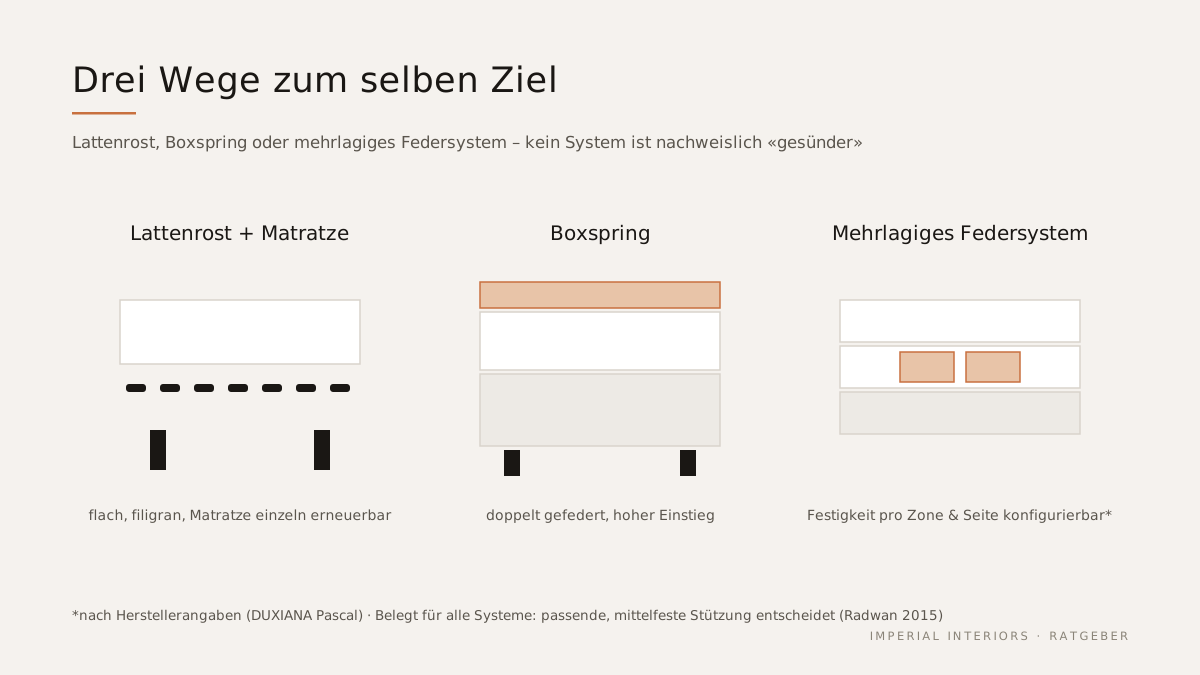
Where the systems really differ
Three construction principles, three times the same goal – supporting the spine correctly: in the classic bed, a slatted frame carries an independent mattress; the system sits lower, looks visually lighter and the mattress can be replaced on its own – this is how our Italian Flou beds work with innerspring mattresses. The box-spring bed replaces the slatted frame with a sprung, upholstered box, topped by a mattress and usually a topper: double suspension, a noticeably higher entry, a commanding hotel look. Multi-layer spring systems such as DUXIANA's, finally, stack continuous spring layers and make the firmness adjustable – according to the manufacturer – via replaceable cassettes per zone and side of the bed.
What research says – and what it does not say
Honesty first: we know of no independent study that directly compares box-spring and slatted-frame systems in terms of sleep quality or health. What is proven is something else – and it applies equally to all construction types: subjectively medium-firm, individually fitting support performs best in controlled studies, sagging systems measurably worsen sleep (shown for side and prone sleeping – the most common positions), and a dry, not overheated bed climate is important. The system question is therefore not a health question but one of comfort preferences, looks and handling. Anyone selling you one system as “the healthier one” is selling you marketing.
The practical differences that count
- Entry height: box-spring beds sit noticeably higher – which makes getting up easier (the effect is documented for seat heights on chairs; carrying it over to beds is plausible and matches our consulting experience).
- Looks & room presence: slatted-frame beds appear more delicate and more “Italian”, box-spring more imposing and more hotel-like – purely a matter of taste.
- Renewability: with the slatted-frame system you replace the mattress on its own; with box-spring the topper, more rarely the mattress; with DUX, according to the manufacturer, cassettes and top pads.
- Climate: the principle is documented – trapped heat and moisture disturb sleep. Open spring structures and slatted frames let air circulate by design; blanket study proof of which system regulates climate better is lacking.
- The topper question with box-spring: Scandinavian construction with a replaceable topper (hygiene advantage), American with an integrated comfort layer (e.g. King Koil) – a convention, not a quality ranking.
Which suits whom?
From our daily consulting, as orientation and without dogma: the slatted-frame bed with innerspring mattress suits anyone who prefers to lie lower, looks for design lightness and wants to renew the mattress independently of the bed. The box-spring bed suits anyone who loves the high entry, the double-sprung, “full” lying feel and the hotel look – particularly appreciated when knees or hips make getting up harder. The multi-layer spring system suits anyone who wants maximum adaptability – couples with different needs, say, who still want a continuous lying surface. The decision is made most reliably where all three systems stand side by side: by trying the beds directly.
Frequently asked questions
Which is better: box-spring bed or bed with slatted frame?
Neither is demonstrably better or healthier – comparative studies do not exist. What is proven: the decisive factors are fitting, medium-firm support and an intact system, whatever the construction type. The choice is a question of lying height, looks, renewability and personal lying feel.
Is a box-spring bed healthier than a normal bed?
There is no scientific evidence for that. Healthy is whatever supports your spine correctly and suits your body – any of the systems can deliver that. The box-spring bed's higher entry is, however, a practical comfort advantage when getting up.
Does a box-spring bed need a topper?
It depends on the construction: the Scandinavian variant is designed for a (replaceable) topper – with a hygiene advantage. The American construction, at King Koil for instance, integrates the comfort layer into the mattress. Both are conventions, not a question of quality.
Can I use any mattress with a slatted-frame bed?
In principle, the system is modular – that is precisely its advantage. Mattress and base suspension should, however, be matched to each other (support surface, zoning). With our Flou beds, we combine slatted frame and innerspring mattress to fit – and check the combination when you try the bed.
Sources & studies
The factual statements in this article are based on the following sources — each framed in the text as a study, testing institute, official figure, convention or manufacturer information:
- Radwan A et al. (2015): Systematic review – mittelfeste, individuell passende Stützung optimal; Bauart-übergreifend. Sleep Health 1(4):257–267.
- Verhaert V et al. (2011): Durchhängende Liegesysteme verschlechtern den Schlaf messbar (gezeigt für Seiten- und Bauchlage). Ergonomics 54(2):169–178.
- Okamoto-Mizuno K, Mizuno K (2012): Wärme-/Feuchtestau stört den Schlaf (Bettklima-Grundsatz). J Physiological Anthropology 31:14.
- Kuo YL (2013): Höhere Sitzflächen erleichtern älteren Menschen das Aufstehen (Stuhl-Studie; Analogie zur Betthöhe). Aging Clin Exp Res 25(3):305–309.
- DUXIANA: Continuous Springs / Pascal System (Herstellerangaben zu mehrlagigen, konfigurierbaren Federsystemen).
Note: This article provides general knowledge and does not replace medical advice. Persistent complaints should be clarified by a doctor.
Prefer personal advice?
Initial consultation, first home visit and initial concept are free and non-binding. Try our beds any time in the showroom at Nüschelerstrasse 30, Zurich.