
160, 180 or 200? Bed Size and Mattress Split for Couples
The two questions that precede almost every bed order: how wide should it be – and one continuous mattress or two separate ones? The proven rule of thumb is 90 centimetres of lying width per person; from 180 cm, couples sleep comfortably. On the mattress question, weight difference and lying preferences decide – and there is a way that combines both worlds.
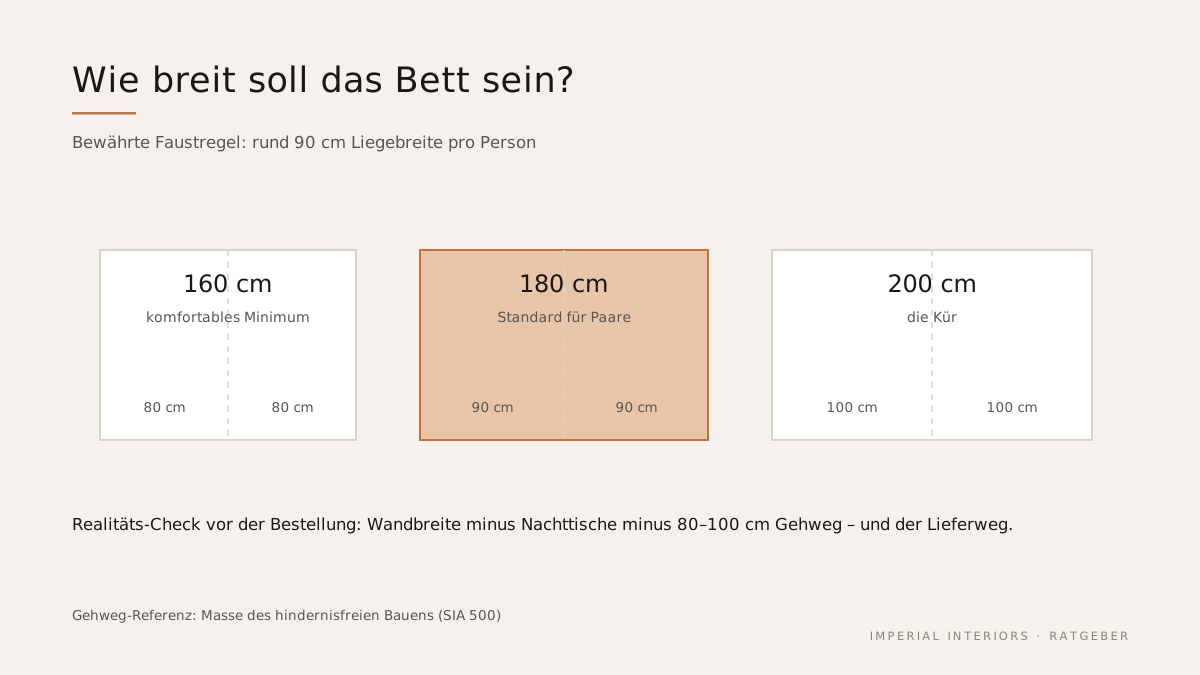
How wide? The 90-centimetre rule
The bed industry's proven rule of thumb – and we label it honestly as such – is around 90 centimetres of lying width per person: enough to fold your arms behind your head without touching your partner. For couples, that means: 160 cm is the comfortable minimum, 180 cm the standard for undisturbed sleep, and 200 cm the luxury for anyone who loves space or whose child or dog regularly climbs in. Bear in mind the objectively measured reality of sleeping: we change position on average a good one and a half times per hour – about a dozen times a night. Freedom of movement is not a luxury but part of healthy sleep.
Does it fit the room – and through the stairwell?
Two checks before any size decision. First, the room: the main walkways around the bed should remain clear – we have not found a standard for this; 80–100 cm is our comfort recommendation (the 80 and 100 cm of barrier-free building apply to doors and corridors, not to bedrooms). Add up bed width plus both bedside tables plus walkway: with a 180 cm bed that quickly exceeds 300 cm of wall. Second, the route into your home: stairwell, lift and door widths help decide whether a 200 cm bed or a continuous 180 mattress can be delivered at all. We check the delivery route before every order – with tricky period buildings, it is the most important question of all.
One mattress or two? The honest trade-off
The continuous mattress offers a seamless lying surface without a gap between mattresses – ideal for couples of similar weight with similar preferences. Two separate mattresses, on the other hand, allow individual firmness per side; the industry's common rule of thumb names a weight difference of around 15 kilograms as the threshold above which separate tuning becomes worthwhile – a convention, not a standard, because what matters are the actual lying needs (ergonomics research shows this too: the right support depends on build and sleeping position). Against the gap between two mattresses, gap fillers and a continuous topper help – and the topper also evens out the lying feel.
The third way: one mattress, two firmness levels
High-quality systems resolve the dilemma more elegantly. With the DUXIANA Pascal system, for instance – according to the manufacturer – spring cassettes in three firmness levels can be swapped for the shoulder, hip and leg zones, separately for each side of the bed: a continuous lying surface without a gap, yet individually tuned support per person, adjustable later if weight or needs change. With box-spring beds, too, much can be configured per side. In short: if you are asking “one or two?”, you should also check “or both?” – when trying the bed together.
Swiss dimensions at a glance
Practical notes for ordering in Switzerland:
- Common double-bed widths: 160, 180 and 200 cm at a length of 200 cm; from a body height of ~185 cm, a look at 210 cm lengths pays off (availability depends on the model).
- Think of the bed linen: in Switzerland, 160×210 cm is the usual duvet size (a convention) – on 180 cm beds, many couples sleep with two single duvets, Nordic style.
- Room size as a reality check: wall width minus bedside tables minus walkway (our comfort recommendation of 80–100 cm) = maximum bed width.
- Try the bed as a couple – the right width can only be felt together.
- Clarify the delivery route before ordering (stairwell, lift, doors) – we check this as standard.
Frequently asked questions
Which bed size for 2 people: 160 or 180?
Rule of thumb: 90 cm of lying width per person. 160 cm is the comfortable minimum for couples, 180 cm the standard for undisturbed sleep – and the right choice if the room allows it. 200 cm pays off for space lovers or when children/pets are regularly in the bed.
One large mattress or two small ones in a double bed?
Similar weight and similar preferences: one continuous mattress (no gap between mattresses). Clear weight difference (rule of thumb: from ~15 kg) or different firmness preferences: two separate ones – with a continuous topper against the gap. Third way: systems such as DUX Pascal offer a continuous mattress with firmness configurable per side.
How big does the bedroom need to be for a 180 cm bed?
Calculate realistically: a 180 cm bed + both bedside tables + walkway (our comfort recommendation: 80–100 cm, not a standard) quickly adds up to more than 300 cm of required wall width. Measure the delivery route as well – stairwell and doors have a say too.
What can be done about the gap between mattresses?
A continuous topper across both mattresses is the most effective solution and also evens out the lying feel; gap fillers are the simple alternative. If you want to avoid the gap altogether, choose a continuous mattress – if needed, with firmness configurable per side.
Sources & studies
The factual statements in this article are based on the following sources — each framed in the text as a study, testing institute, official figure, convention or manufacturer information:
- Skarpsno ES et al. (2017): Sleep positions and nocturnal body movements (Aktigraphie: regelmässige Positionswechsel). Nature and Science of Sleep 9:267–275.
- Verhaert V et al. (2011): Ergonomics in bed design – Stützbedarf hängt von Körperbau und Schlafposition ab. Ergonomics 54(2):169–178.
- Schweizer Fachstelle Hindernisfreie Architektur: Türen und Durchgänge in Wohnbauten (Masse für Türen und Korridore nach SIA 500; keine Angaben zum Schlafzimmer).
- DUXIANA: The Pascal Customizable Support System (Herstellerangaben: Festigkeit pro Zone und Bettseite konfigurierbar).
Note: This article provides general knowledge and does not replace medical advice. Persistent complaints should be clarified by a doctor.
Prefer personal advice?
Initial consultation, first home visit and initial concept are free and non-binding. Try our beds any time in the showroom at Nüschelerstrasse 30, Zurich.