
Outdoor Furniture: Understanding Materials, Caring Properly, Overwintering Well
Good outdoor furniture is materials science: teak protects itself through its natural oil content and weathers to a silvery grey in the sun – that is surface physics, not damage. Aluminium and stainless steel do not rust, for two different, well-documented reasons. And with fabrics, the fibre dyeing decides colour fastness. If you know these connections, you spend less on care and enjoy your furniture longer – the honest fundamentals, winter storage checklist included.
Teak: the benchmark – with an honest nuance
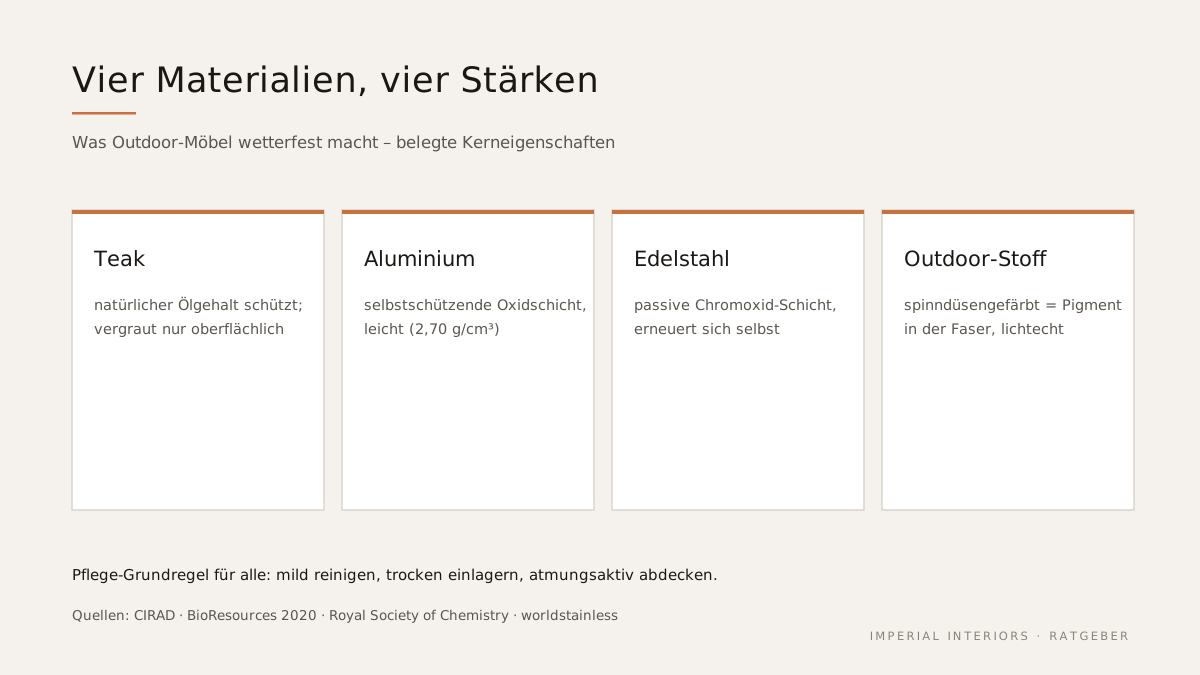
Teak (Tectona grandis) owes its reputation to two properties: a solid density (around 0.67 at twelve percent wood moisture) and above all its natural wealth of oil and resin, which protects the wood from within against moisture and fungi. The honest nuance that often gets lost in the furniture trade: the research institute CIRAD rates teak's durability against fungi in classes 1 to 3 – “very durable to moderately durable, depending on the origin and age of the stands”. Old forest teak reaches the top class; today's market, however, consists almost entirely of plantation teak, whose durability varies more strongly. For buying, that does not mean “hands off”, but rather: ask about the origin and quality of the teak – reputable manufacturers will provide that information.
The silver-grey patina: physics, not damage
Why does teak – like any untreated wood – turn grey outdoors? Wood research has described the mechanism cleanly: UV light photochemically breaks down the lignin in the outermost layer of wood, about one to two millimetres thin; rain washes out the soluble degradation products, and what remains are the lighter cellulose fibres – the characteristic silver-grey patina. The decisive point: the process is purely superficial and does not materially impair the substance. Greying is therefore a question of taste, not a damage report. If you prefer the honey-coloured as-new state, clean the wood periodically and treat it with teak oil or teak protector – a widespread manufacturer recommendation that means work and is motivated purely by looks. If you like the patina, you need to do nothing at all.
Aluminium and stainless steel: two routes to rust protection
Both metals are reliable outdoors, but for different, well-documented reasons. Aluminium (density 2.70 g/cm³ – which is why it is so pleasantly easy to move around) forms of its own accord in air a microscopically thin oxide layer that protects the surface against further corrosion; the powder coating customary in furniture making – electrostatically applied, baked-on polyester powder – lays an additional, colour-giving protective skin over it (process description, trade convention). Stainless steel works differently: from a good 10.5 percent chromium content, a passive, chromium-rich oxide layer forms, which renews itself on contact with oxygen – scratches “heal” chemically. Neither of the two materials is better across the board: aluminium scores with its low weight and variety of colours, stainless steel with robustness and its self-healing surface. The one care rule applies to both: mild soapy water instead of scouring agents, so that the protective layers remain intact.
Fabrics and weave: what connoisseurs look for
With outdoor cushions and covers, the dyeing technique decides how long the colour lasts: in solution-dyed acrylic fibres, the pigment sits in the fibre mass itself, not just on the surface – the established quality convention for colour-fast outdoor textiles. Colour fastness can be measured through standardised test methods: ISO 105-B02 tests light fastness under xenon light, ISO 105-B04 fastness under artificial weathering with rain spray – anyone comparing fabric qualities may ask about these test values. As for weave, UV-stabilised HDPE synthetic wicker has established itself as today's standard for high-quality furniture (trade convention): insensitive to moisture and dimensionally stable – permanent point loads, however, are not to its liking.
Care and winter storage: the checklist
The largest part of outdoor care is proven practical knowledge – and we label it as such:
- Teak may stay outside all year round and turn grey; only if you want the honey tone do you clean and oil – looks, not duty.
- Clean metal and wood surfaces before putting them into storage and let them dry completely.
- Choose breathable protective covers and never cover airtight – condensation collects under sealed tarpaulins, and with it the risk of mould rises.
- Store upholstery and cushions dry and indoors over the winter – they are the most delicate part of any set.
- Clean aluminium and stainless steel with mild soapy water; scouring agents and hard brushes damage the protective layers.
- When in doubt, consult the manufacturer's care instructions – for our Unopiù and azado pieces, we advise on this directly in the showroom.
Frequently asked questions
Do I have to oil teak furniture – or can I simply let it turn grey?
Both are right: the silver-grey patina is a purely superficial UV effect (lignin degradation in the outermost layer) and does not harm the substance. Oiling is an aesthetic decision in favour of the honey tone – with the care effort that entails, not a necessity.
Aluminium or stainless steel in the garden – what is the difference?
Neither rusts, but for different reasons: aluminium protects itself with a self-forming oxide layer (plus powder coating) and is considerably lighter; stainless steel forms, from a good 10.5% chromium, a passive layer that renews itself when scratched. The choice is a question of weight, look and place of use – not of “better or worse”.
Can I leave garden furniture outside in winter?
Teak, powder-coated aluminium, stainless steel and HDPE weave can in principle cope with winter; cushions, however, always belong indoors, kept dry. If you cover, use breathable covers – airtight tarpaulins promote condensation and mould. The care instructions of the respective manufacturer remain authoritative.
What does “solution-dyed” mean for outdoor fabrics?
That the colour pigment is bound into the fibre mass during fibre production instead of being dyed on only at the surface – the quality convention for particularly colour-fast and light-fast outdoor textiles. Light fastness is verified through standardised tests such as ISO 105-B02/B04.
Is plantation teak as good as old forest teak?
Not automatically: the research institute CIRAD rates teak, depending on origin and stand age, in durability classes 1 to 3 – old forest teak sits at the top, plantation teak varies more strongly. That is why the question about origin and quality pays off; reputable manufacturers will provide answers.
Sources & studies
The factual statements in this article are based on the following sources — each framed in the text as a study, testing institute, official figure, convention or manufacturer information:
- CIRAD Tropix: Technisches Datenblatt TEAK (Tectona grandis) – Dichte, Ölgehalt, Dauerhaftigkeitsklassen nach EN 350.
- Kropat M, Hubbe MA, Laleicke F (2020): Natural, accelerated, and simulated weathering of wood – A Review. BioResources 15(4):9998–10062 (UV-Lignin-Abbau, Vergrauung).
- Royal Society of Chemistry: Aluminium – Dichte 2,70 g/cm³, selbstschützende Oxidschicht.
- worldstainless: Corrosion properties – passive, selbstregenerierende Chromoxidschicht ab >10,5 % Chrom.
- ISO 105-B02:2014 – Farbechtheit gegen künstliches Licht (Xenon); die Schwesternorm ISO 105-B04 (künstliche Bewitterung) hat eine eigene Katalognummer.
Prefer personal advice?
Initial consultation, first home visit and initial concept are free and non-binding. Try our beds any time in the showroom at Nüschelerstrasse 30, Zurich.