
Mattress Firmness: Why “H3” Says Little – and What Counts
Firmness ratings such as H2 or H3 are not standardised – every brand defines them itself, and even the European test standard EN 1957 is based on subjective perception. Research shows that the most favourable sleep surface is one that feels subjectively medium-firm and fits your body individually. So rely on testing the bed in person, not on the label.
There Is No Standardised Firmness Scale
H1 to H5, “medium”, “firm” – firmness ratings look like a technical standard, but they are marketing conventions of individual manufacturers. A biomechanical review notes that even the European test standard EN 1957 relies on subjective perception, and that the concepts of firmness and comfort are considered “highly diverse and vague” in the research. The consequence for your purchase: one brand's “H3” can feel firmer than another's “H4”. Stiftung Warentest, the German consumer testing organisation, also regularly finds that declared firmness and measured support characteristics diverge.
What the Studies Show Instead
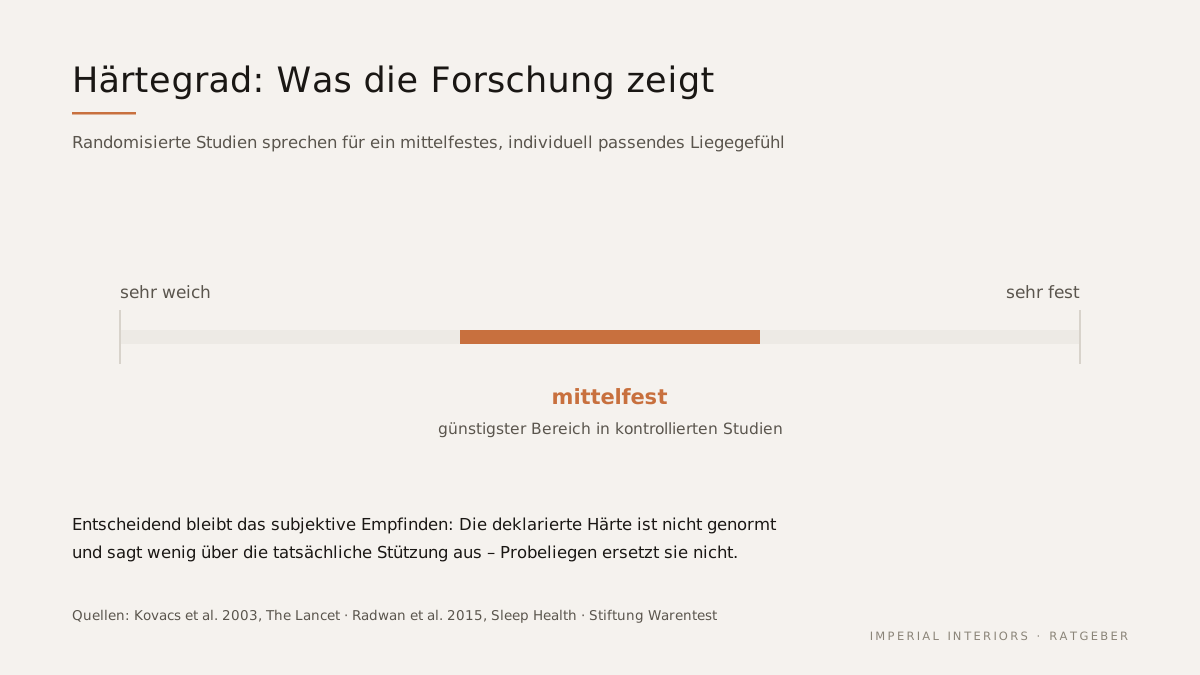
Across 24 controlled studies, the picture is consistent: a sleep surface subjectively perceived as medium-firm, ideally adjustable, is on average the most favourable for sleep comfort, pain reduction and spinal alignment. The randomised Lancet study by Kovacs confirms this for people with chronic low-back pain. Important context: these are group averages. A small polysomnographic study found the medium-firm option optimal explicitly only for people with a moderate BMI – the “right” firmness level remains individual.
Weight, Body Type, Position: Plausible, but Only Partly Proven
The common rule of thumb “the heavier, the firmer” is biomechanically plausible but only weakly supported scientifically – robust studies assigning specific weight classes to specific firmness levels are lacking. The influence of sleeping position is better documented: sagging support disturbs side and stomach sleepers the most. We say this so plainly because serious consultation has to stop where the evidence ends – from that point on, your personal lying feel is what counts.
How to Find Your Firmness
Drawn from the research and our consulting practice:
- Start with medium-firm, then compare in both directions.
- Always test in your main sleeping position – in the side position, the spine should form a straight line.
- Do not compare firmness ratings across brands; compare how the bed feels and supports you.
- Zoned or adjustable systems allow fine-tuning when your shoulder and hip areas need different sink-in depths.
- Sharing the bed? Both partners should test it – if need be, combine two different firmness levels in one bed.
Frequently asked questions
Is there an official firmness standard (H1–H5)?
No. Firmness ratings are manufacturers' own designations without a binding standard; even the European test standard EN 1957 is based on subjective perception. Ratings from different brands are therefore not directly comparable.
Which firmness suits my body weight?
There is no scientifically established mapping of weight to firmness level – the rule “heavier means firmer” is plausible but only provisionally supported. More reliable is testing in your own sleeping position: the spine should stay straight, while the shoulders and pelvis should be able to sink in.
Why does “medium-firm” feel different with every brand?
Because every brand defines its own scale, and construction, materials and build shape the lying feel more than the label does. That is why no firmness rating can replace testing the bed in person.
Sources & studies
The factual statements in this article are based on the following sources — each framed in the text as a study, testing institute, official figure, convention or manufacturer information:
- Wong DW et al. (2019): Sleeping mattress determinants and evaluation – a biomechanical review and critique. PeerJ 7:e6364.
- Radwan A et al. (2015): Systematic review of controlled trials on mattress design, sleep quality and spinal alignment. Sleep Health 1(4):257–267.
- Kovacs FM et al. (2003): Effect of firmness of mattress on chronic non-specific low-back pain. The Lancet 362:1599–1604.
- Hu X et al. (2025): The Effect of Mattress Firmness on Sleep Architecture and PSG Characteristics. Nature and Science of Sleep.
- Verhaert V et al. (2011): Ergonomics in bed design. Ergonomics 54(2):169–178.
- Stiftung Warentest: Matratzen im Test – Kaufberatung und Testmethodik.
Note: This article provides general knowledge and does not replace medical advice. Persistent complaints should be clarified by a doctor.
Prefer personal advice?
Initial consultation, first home visit and initial concept are free and non-binding. Try our beds any time in the showroom at Nüschelerstrasse 30, Zurich.